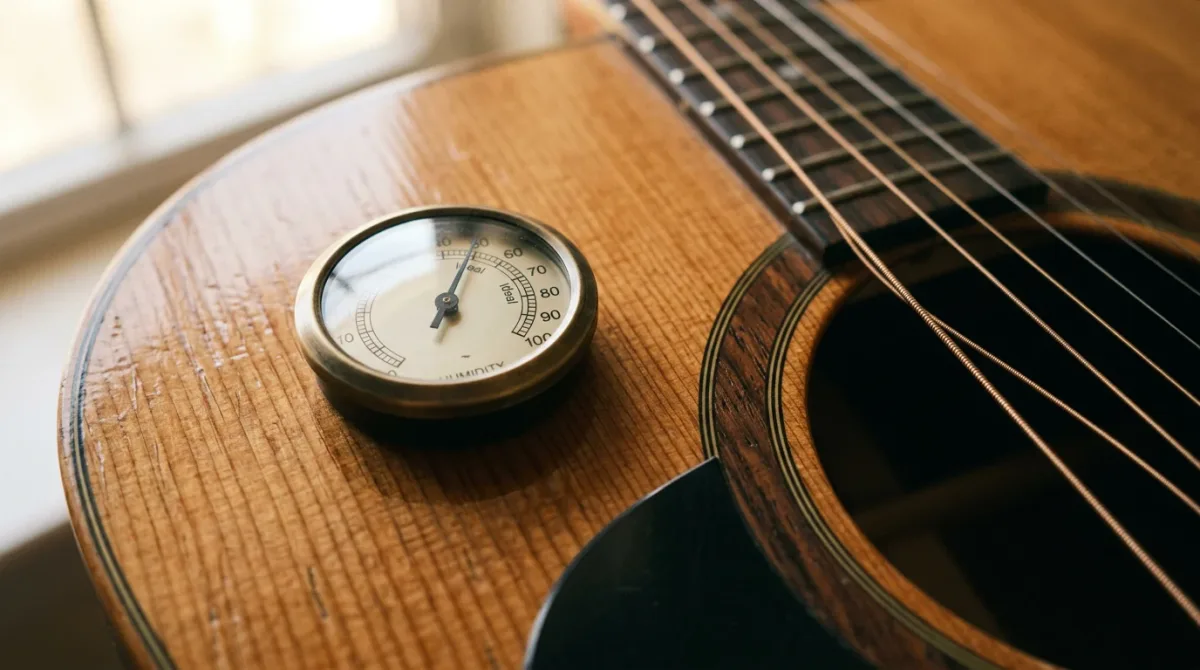
Relative humidity decides how much water sits inside your guitar's wood, and that moisture content decides whether the top, back, and fingerboard swell or shrink under string tension. That is why the care sheets from two of the biggest American acoustic builders land on the same narrow window rather than a vague instruction to keep the instrument comfortable.
What is actually happening inside the wood?
Wood is hygroscopic: it takes on or gives up water until its moisture content is in equilibrium with the air around it. Change the room's relative humidity and that equilibrium point moves with it. Below roughly 30 percent moisture content, the wood does not just get damp or dry — it physically swells or shrinks.
The reference numbers come from Chapter 4 of the U.S. Forest Products Laboratory's Wood Handbook, by Samuel V. Glass and Samuel L. Zelinka. Its Table 4-2 gives equilibrium moisture content at 70°F: 8.5 percent at 45 percent relative humidity, 9.2 percent at 50 percent, and 10.1 percent at 55 percent. Let the room drift to 30 percent RH and the figure falls to 6.2 percent; let it climb to 70 percent and it reaches 13.1 percent.
So the widely quoted 45-to-55-percent window is, in wood terms, a swing of about 1.6 percentage points of moisture content. A dry winter room roughly doubles that excursion downward. The moisture relations chapter of the Wood Handbook also sets the threshold where movement begins: the fiber saturation point "averages about 30% moisture content," and below it shrinkage "continues in a fairly linear manner until the wood is completely dry."
The movement is not uniform. Wood shrinks and swells most in the direction of the annual rings, "about half as much across the rings (radially), and only slightly along the grain (longitudinally)" — longitudinal shrinkage averaging 0.1 to 0.2 percent, per the same chapter. For a guitar that means the wide, flat plates move across their width while their length stays nearly fixed, which is the movement the braces glued across them have to absorb. None of the sources here measured that stress on an assembled instrument.
Why do the big builders name the same 45-to-55-percent window?
Because they build in it. Taylor Guitars states that its instruments are "built in a controlled environment where the relative humidity is 46 percent," and both Taylor and Martin publish 45 to 55 percent RH as the target for storage and play. Martin adds a temperature figure; Taylor's humidification page does not.
| Maker | Published RH target | Published temperature target | Source document |
|---|---|---|---|
| Taylor Guitars | 45-55% RH | Not specified in the cited pages | Taylor support pages on using a guitar humidifier and on symptoms of a wet guitar |
| Martin Guitar | 45-55% | "72-77 degrees Fahrenheit is the optimal temperature" | Martin's acoustic guitar maintenance guide, published May 10, 2023 |
Both figures are the makers' own guidance for their own instruments, not independent measurement — no supplied test measured how a finished, braced, lacquered guitar tracks the bare-wood equilibrium curve. Martin's maintenance guide also recommends the cheap part of the job first: "We suggest investing a few bucks in a hygrometer and thermometer to monitor the relative humidity levels and temperature in your guitar's environment."
How do you tell a dry guitar from a wet one?
By which direction the symptoms run. A dry instrument shrinks: the top sinks, the action drops, fret ends start to catch. A wet one swells in the opposite direction: the action climbs and the sound goes flat. Both makers describe the pattern in their published care documents.
Taylor's humidifier page lists the dry-side consequences as "bad string action and buzzing, protruding fret ends, wood cracking, top sinking, bridge lifting." On the wet side, Taylor's page on the symptoms of an over-humidified guitar names four signs:
- "High action" — "strings that are unusually high off the fretboard, making it difficult to play."
- "Dulled sound" — the guitar "sounds dull and lifeless."
- Back swelling on either side of the end block, "creating a low spot in the middle."
- A changed neck angle: sighting the neck to the bridge, "the frets will appear to hit below the bridge."
Taylor's own caveat is worth more than the list: every guitar shows some back swell behind the bridge, so a single sign proves nothing. Look for several at once. Martin's guide frames the same two directions more broadly — too little moisture risks "cracking or warping," too much makes wood "swell, which can affect the guitar's playability and intonation."
Can you trust the hygrometer telling you all this?
Not automatically. Taylor's guidance is to use a digital hygrometer and warns that "analog or needle-style models fall out of calibration easily." A cheap meter reading eight points high will keep you comfortable while the instrument dries out, which is the failure mode worth checking before you buy a humidifier.
The standard bench check uses a saturated salt solution as a known reference point, and that reference is genuinely documented. Lewis Greenspan's fixed-point measurements, published in the Journal of Research of the National Bureau of Standards in 1977, put the equilibrium relative humidity over saturated sodium chloride at 75.47 ± 0.14 percent at 20°C and 75.29 ± 0.12 percent at 25°C. The procedure below is general practice rather than a step sequence any of these sources prescribes; the number it checks against is the sourced part.
- Make a slurry of table salt and a little water in a small open cup — damp enough to clump, not a solution you could pour.
- Seal the cup and the hygrometer together in an airtight bag or container, not touching.
- Leave the container at a stable room temperature, undisturbed, for several hours.
- Read the hygrometer through the container. Compare it against roughly 75 percent, per Greenspan's published fixed points, and note the offset.
- Apply that offset to every later reading, or replace the meter if it is far out.
What should you actually do across the seasons?
Measure first, then correct in whichever direction the room is drifting, and keep the guitar in its case when you are not playing it. Neither maker's documents claim a humidifier is optional in a dry climate; both treat monitoring as the constant and the device as the response.
Taylor's humidifier guidance names two products it endorses for the dry season: D'Addario's Two-Way Humidification System, which the company describes as holding 45 to 50 percent, and the Oasis OH-1, a watertight container with a specialized fabric. For the opposite problem, Taylor's over-humidification page suggests silica gel or bamboo charcoal packs in the case, changed every few months, a room dehumidifier for persistent damp, and periodically drying the case interior with a blow dryer for 10 to 15 minutes.
None of that is exotic, and none of it is expensive next to a top repair. The honest limit of this evidence: the Wood Handbook numbers describe wood, not finished guitars; the symptom lists and RH targets are the makers' own statements about their own instruments; and no supplied test measured how fast a cased guitar responds to a change in room humidity, or how any of the named humidification products perform under measurement. What the sources do settle is the mechanism and the target. The rest is a hygrometer you have checked and the discipline to look at it.
For a related guitars perspective, read The Right Humidity for an Acoustic Guitar, Explained.