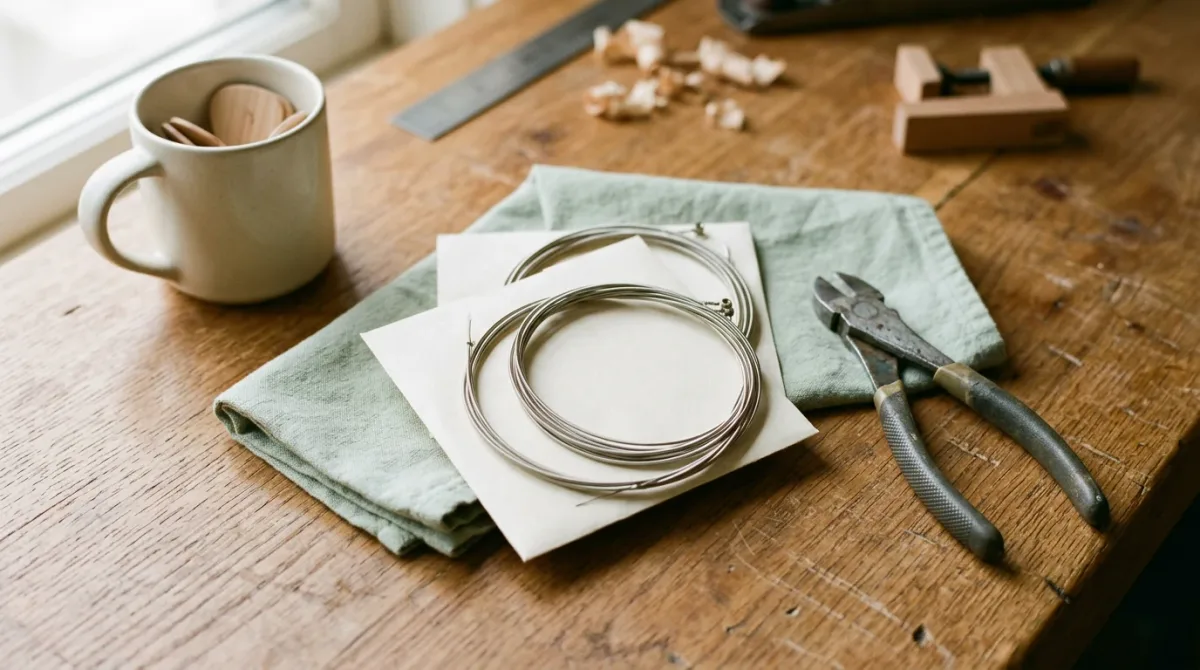
For a casual player, the major string makers' published guidance points to the same window — change acoustic or electric strings every three months or roughly 100 playing hours, whichever arrives first, per guidance from D'Addario's and Ernie Ball's own care materials. Working players change far more often; some touring guitarists change strings before every show, per techs' documented accounts in published interviews. The honest answer is that the clock starts when tone dies, and the makers' windows are averages, not appointments.
Strum Magazine writes from maker documentation and named published accounts — no hands-on impressions. What follows is what the sources establish and what they leave to your ear.
Why do strings go dead at all?
Dead strings are dirty strings. Skin oils, sweat, and airborne grime build up in the windings and dampen the high harmonics first, which is why a dying set sounds dull before it feels rough — the corrosion explanation string makers including D'Addario publish in their string-care guidance. On acoustic sets the core also fatigues, and intonation drifts as the wrap loses uniformity, per the same materials.
The process runs on contact, not calendar. A guitar played daily in a humid room ages its strings faster than a case-kept weekly strummer, which is why the 100-hour figure is the more useful of the two rules.
What are the signs it's time?
Four signals, in the order they usually arrive, consistent across the makers' care guides and documented player accounts:
- Tone loses sparkle first — the top end thins even after the strings are clean.
- Intonation drifts: chords sound sour higher up the neck even after tuning.
- The wound strings feel gritty or look dark under the light, especially near the frets you use most.
- Tuning stability drops, because dirty windings bind in the nut and at the bridge.
Any one of these is the string telling you its age. Two of them together, and the set is done pretending.
Can you extend string life?
Yes, and the cheap measures do most of the work: wipe the strings down after playing with a dry cloth, per both D'Addario's and Ernie Ball's published care guidance, and wash your hands before you play. String cleaners and coated strings add margin — coated sets, which makers report lasting several times longer in their own product materials, trade a measure of brightness for lifespan, a trade-off the coated-string makers themselves acknowledge in their marketing claims.
The budget candor Strum Magazine owes you: the cloth does most of what the sprays do, and plain strings wiped nightly outlast premium strings ignored. Spend the difference on an extra set.
Does string gauge or type change the schedule?
Bigger strings have more mass to lose brightness from and plain third strings wear differently than wound ones, but the makers' guidance doesn't publish separate schedules by gauge — the 100-hour window covers the product line. Flatwounds, favored by jazz players for their longevity and thump, hold tone longer because their flat wrapping traps less grime, per the flatwound makers' own descriptions. Coated sets stretch the window longest; that's the maker's claim, with no independent test supplied.
What the sources don't establish: any exact tone-death date for your hands, your humidity, and your attack. The 100-hour figure is a maker's average, the player accounts are individual, and your ear — on a clean, tuned instrument — is the instrument that actually measures it.