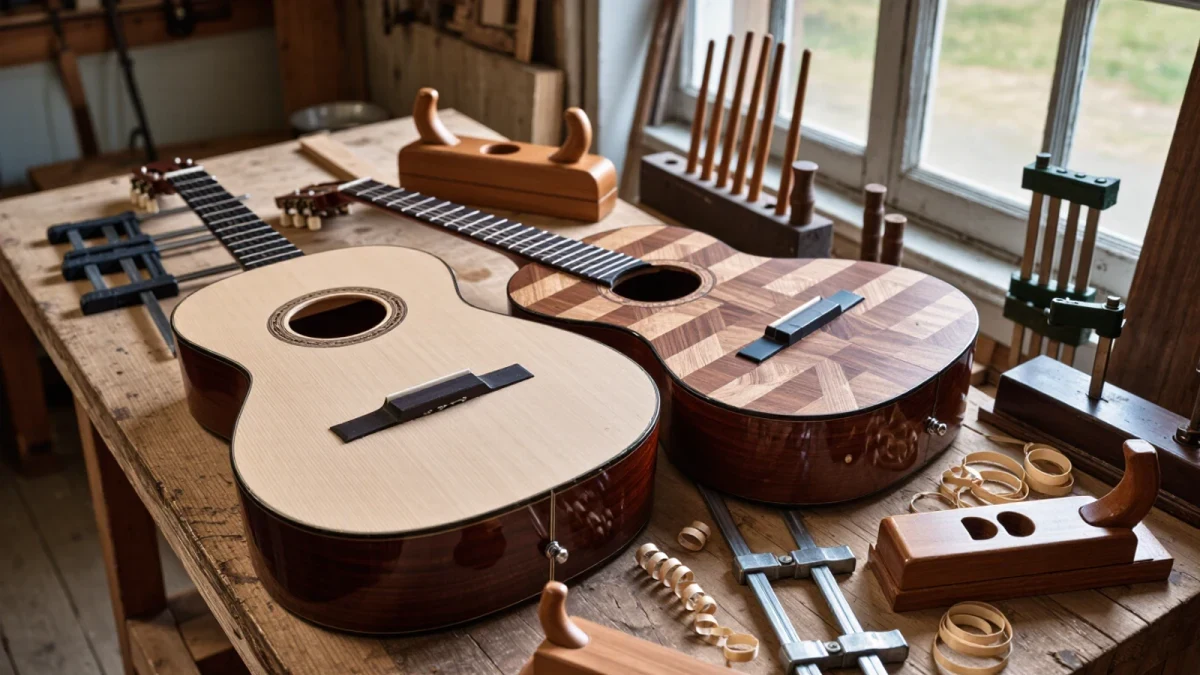
Fan bracing — seven struts fanned under the top, standardized by Antonio de Torres in the 1850s — produces the warm, rounded voice most listeners call the classical guitar sound, while lattice bracing uses a crosshatched grid of thin struts to make a stiffer, lighter top that plays noticeably louder. Builders of lattice instruments, including the Australian school that popularized the design, describe volume gains that traditional makers accept as real. The choice between them is now the biggest fork in buying a modern classical: traditional tone versus modern projection, with a middle category — nominal 'lattice-fan hybrids' — trying to sell you both.
How does fan bracing work?
The fan system puts five to seven struts, arranged like an open fan, under the area of the top between the soundhole and the bridge, plus crossing harmonic bars above and below. The struts run with the grain, stiffening the top along its length while leaving it free to flex across the grain — the motion that pumps air and makes sound. The design survived because it balances two opposites: a top thin and light enough to move, braced strongly enough to withstand roughly 85 pounds of nylon string tension (per D'Addario's normal-tension set figures) for decades.
Its voice, in the traditional makers' own descriptions, is warm, thick in the fundamentals, with strong separation between voices and a rounded attack. Its limitation is output: a fan-braced concert guitar fills a recital hall, but it struggles against a full chamber ensemble or in large modern venues.
How does lattice bracing work?
A lattice top carries a fine grid — struts crossing at angles in both directions, like a waffle — usually cut from very light wood such as balsa or cedar, sometimes laminated with carbon fiber. The grid lets the builder make the plate itself dramatically thinner, because stiffness comes from the structure rather than the wood's thickness. A thinner, lighter plate driven by the same string energy moves more air: that is the volume gain, described consistently by the Australian makers who developed the school from the 1980s onward and by the builders who license the ideas today.
The associated change is tonal. The maker-side descriptions converge on a sound that is louder, faster-responding, and more even across the range, with a cleaner, less rounded attack than a traditional fan. Critics — mostly traditionalists — hear thinness in the color and a voice that records differently than it sounds in the room. Both descriptions are matters of documented maker and player accounts, not measured fact; no supplied published test compares the systems under matched conditions.
What is a double top?
A related third system: two very thin wood skins separated by a honeycomb spacer, usually Nomex, glued as a sandwich. Double tops push the same logic further — an extremely light, stiff plate — and dominate the loud end of the concert market alongside the strongest lattices. Buyers encounter all three under the general heading of 'modern' construction, typically at concert-instrument prices, roughly $8,000 to $20,000 and beyond for hand-built examples as of makers' 2025-2026 lists.
| Factor | Fan bracing | Lattice bracing |
|---|---|---|
| Era of origin | 1850s (Torres) | 1980s (Australian school) |
| Top stiffness strategy | Struts with the grain | Crosshatched grid, thinner plate |
| Described voice | Warm, rounded, fundamental-rich | Loud, fast, even, cleaner attack |
| Typical price tier | All levels, student to concert | Mostly concert tier |
| Repertoire fit | Traditional solo and song literature | Large halls, ensemble and concerto work |
Which system should you buy?
Start from where you play. Solo repertoire at home, in teaching studios, in small halls: a fan-braced guitar serves that music exactly as it has for 170 years, and the student-to-concert price ladder in fan-braced instruments is deep and full of value. Concert work in large venues, chamber collaborations with violinists or flutists who project, concertos with orchestra: the volume headroom of a lattice or double top is what those situations were built for, and players in that world increasingly own both.
Try instruments, not categories. Two lattice guitars differ more than the label suggests — strut density, wood choice, plate thickness, and whether carbon stiffening is used all move the sound — and the fan-braced world ranges from light flamenco-blond to dark concert spruce. The bracing pattern is the architecture, not the verdict.
Does bracing affect anything besides tone?
Stability and service life. A very thin lattice or double-top plate is more delicate against impact and can be costlier to repair — specialized damage may need the original builder — while a traditional fan-braced top is the repair world's most familiar surgery. Buyers who travel hard sometimes weigh that alongside sound, and reasonably so.
What the sources do not establish: comparative loudness figures between the systems under matched test conditions, and any controlled study of the aging behavior of lattice versus fan tops. Both camps' tone claims rest on documented maker descriptions and player accounts, attributed above as such.