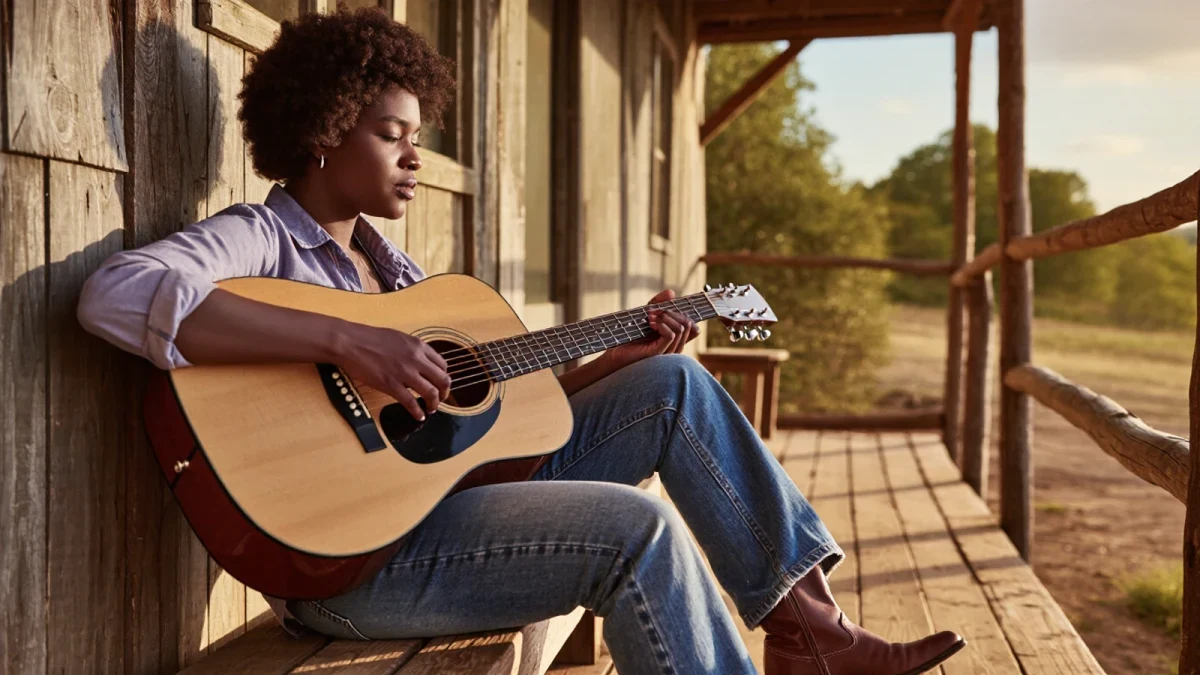
A parlor guitar is a small-bodied acoustic with a narrow waist, a scale typically between 24 and 25 inches, and a body noticeably smaller than a dreadnought — usually 12 to 15 percent shorter in total length. Martin's own size chart, published on the maker's site, places the size 0 as the smallest of its standard historical bodies, and that is the shape most players mean by "parlor." The reward is comfort and midrange focus; the cost is volume and low-end reach.
Strum Magazine publishes sourced guides, not hands-on reviews, so every spec below is attributed to the maker's documentation, and prices are dated to the source's listing. Nothing here rests on an impression.
Where did the parlor guitar come from?
The name is the history. In the late 1800s and early 1900s, guitars were parlor instruments: built for small rooms, gut strings, and sheet-music evenings, not for bandstands. Bodies were compact by necessity — there was no amplification to compete with, and the players were often amateurs in living rooms.
The early blues recording era carried the shape into legend. Robert Johnson's 1936-1937 sessions, as archivists and guitar historians have documented, were played on small-bodied Gibson and Martin-style instruments of the period — not the dreadnoughts later associated with the blues. When you hear the tight, vocal midrange of those records, you are hearing the parlor formula at work. The guitar's shift from parlor to stadium, which BBC Future traced in its history of the instrument, is what pushed bodies bigger — first the dreadnought in the 1916-1930s era, then amplification itself.
What defines a parlor guitar today?
There is no ISO standard, but makers converge on the same numbers. Expect a lower bout around 13 to 13.75 inches wide, a total body length in the 18-to-19-inch range, and a 12-fret neck joint, which moves the bridge toward the center of the top. Scale length runs roughly 24 to 24.9 inches — shorter than the 25.5 inches of a standard steel-string, per the spec sheets of current parlor models.
Two current examples frame the price range. The Gretsch G9500 Jim Dandy, per Gretsch's spec sheet, carries a compact body and a short scale in an agathis build, listed around $199 by major retailers as of December 2025. At the other end, Eastman's parlor offerings and mid-tier Martins occupy the $600-1,500 band, with torrefied spruce tops and all-solid wood. The spec delta is wood quality and decoration, not the fundamental size formula.
How does a parlor sound compared to a dreadnought?
Per the makers' own descriptions — and this is a claim, not a measurement — parlors emphasize the midrange, with quick attack and early note decay. The smaller air volume moves less low frequency, so the bass is present but not authoritative. A dreadnought's bigger box shifts energy down and out; that is why it became the default for strumming in ensembles.
What the sources do not establish is any objective loudness or tonal measurement of modern parlors against modern dreadnoughts in controlled conditions. No supplied test data does that, and honest coverage says so. What is documented is the physical arithmetic: less top area and less internal air volume mean less acoustic output, however efficiently the box is braced.
Who should buy one?
On the supplied evidence, five player types get the most from a parlor:
- Fingerstyle players — the midrange focus and 12-fret bridge placement, per the makers' design notes, suit alternating-bass and melody work.
- Smaller-framed players and younger students — a body 2 to 3 inches slimmer at the lower bout than a dreadnought changes reach and comfort.
- Couch and songwriting players — light, quiet enough for an apartment, and the short scale lowers string tension at the same pitch.
- Blues and roots players — chasing the documented sound of the 1930s repertoire on period-correct geometry.
- Travelers who still want a full-ish experience — a parlor is not a travel guitar, but it packs smaller than anything with a dreadnought waist.
Who should skip one?
If your main job is hard strumming with a band, a parlor is the wrong tool. The smaller top compresses and can lose definition under heavy attack — a limitation the makers themselves acknowledge by aiming their parlor marketing at fingerstyle and blues categories, not stage strumming. Players who need volume for unamplified jams should also look at the size 00 and 000, which add air volume while keeping some compactness. That's the whole trade-off.
What should you check before buying?
Three checks, all doable in a store. First, scale length on the spec sheet: anything from 24 to 24.9 inches is normal; shorter scales mean slinkier tension but tighter fret spacing. Second, nut width: many parlors run 1.69 to 1.75 inches, and fingerstyle players generally want the wider end. Third, solid versus laminate top: at the same price, per the makers' material lists, a solid spruce or cedar top is the upgrade that matters most. Verify current prices at listing time — the $199 figure above is dated December 2025 and will not hold forever.
Segmented simply: a first guitar for a small-framed beginner or a dedicated fingerstyle second guitar — yes, on the documented specs. A do-everything band acoustic — no. The parlor never left because the room it was built for, a person playing in close quarters, never left either.