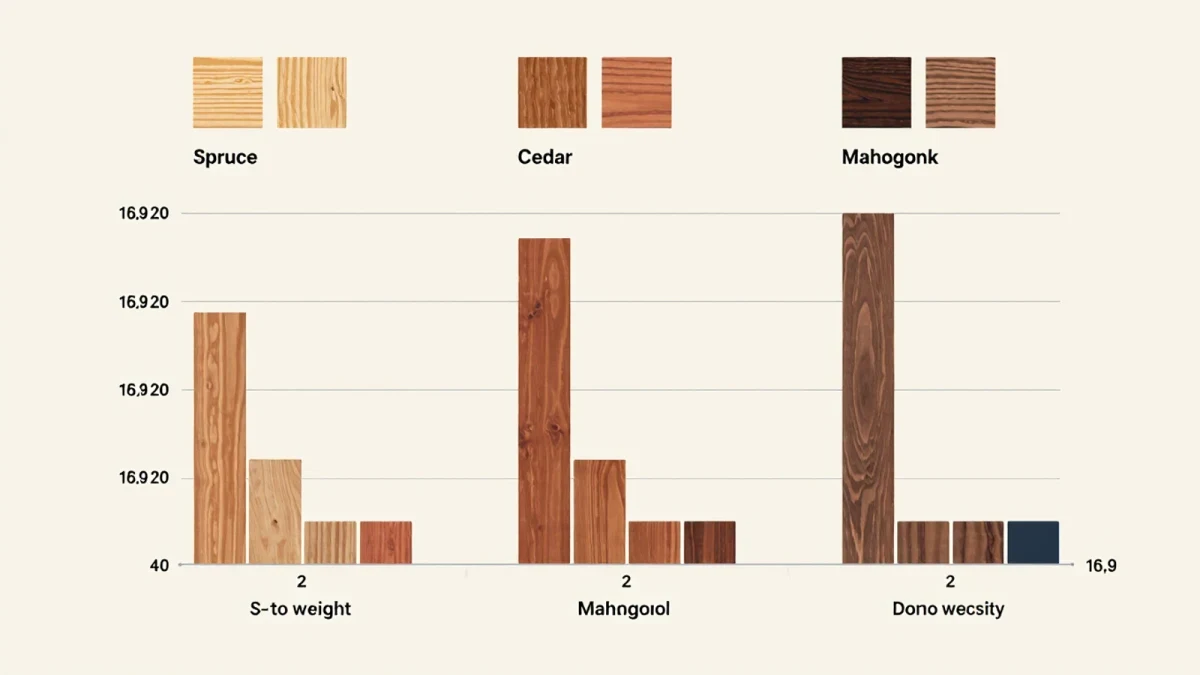
Spruce, cedar, and mahogany are the three most common tonewoods on current acoustic guitar tops, and the maker-claimed differences come down to physics: sitka spruce has a stiffness-to-weight ratio suited to dynamic playing, western red cedar is softer and described as more responsive at low attack, and mahogany is a denser top wood associated with a dry, midrange-forward character. Every one of those descriptions is the maker's claim — no independent measurement standard exists for "warm" or "punchy," and this guide keeps the distinction explicit throughout.
Strum Magazine covers gear from supplied sources, not hands-on impressions. Specs below are attributed to maker documentation; nothing is a verdict on how a specific guitar sounds in a specific room.
What does a tonewood physically do?
An acoustic guitar's top is a vibrating membrane driven by the strings through the bridge. The wood's density and stiffness set how the membrane moves, and luthiers select top wood for a high stiffness-to-weight ratio: stiff enough to project, light enough to move. Back and sides mostly shape how the air inside the body couples to that movement.
Makers publish the species but not lab measurements, so the honest framing is this: species is one variable among bracing, body size, scale length, and build quality. Two sitka-topped guitars from the same maker's line can differ more from each other than two different species from the same builder's bench.
What do makers claim for spruce?
Sitka spruce is the industry default — the most listed top wood across maker catalogs. Per the makers' own material descriptions, it offers broad dynamic range: quiet under a light touch, loud and full under hard strumming. Taylor's and Martin's wood guides both describe sitka as versatile and dynamic, which is why it anchors everything from entry laminates to $3,000-plus concert instruments.
The claimed cost is a longer break-in of responsiveness at very low attack. Engelmann and Adirondack spruce variants sit at the premium end, with Adirondack tied to pre-war instruments and priced accordingly on custom-shop spec sheets. Sitka also dominates the laminate tier: entry-level lines from the major makers list spruce as the outer veneer on laminated tops, so the species name on the hangtag does not automatically mean solid wood. Checking whether the spec sheet says \u201csolid sitka\u201d or just \u201csitka\u201d is the single fastest way to read a listing, because the two constructions differ more in vibration behavior than any species swap does.
What do makers claim for cedar?
Western red cedar tops, per maker descriptions from Cordoba's and Taylor's wood guides, speak earlier: responsive at low attack, with a darker claimed character. It is the default top on many nylon-string guitars and appears on steel-strings aimed at fingerstyle players.
The maker-claimed trade-off is headroom — cedar is a softer wood, and makers themselves describe it as less suited to aggressive flatpicking. If your playing lives between pianissimo and mezzo-forte, the claimed profile fits; heavy strummers are pointed back toward spruce by the same spec sheets.
What do makers claim for mahogany?
Mahogany as a top wood — not just back and sides — appears on makers' "vintage-voice" models. Per the makers' descriptions, it delivers a dry, focused midrange with quick decay, which they market toward blues, roots, and recording players who want note separation over bloom. As a back-and-sides wood, mahogany is consistently described as adding midrange focus compared to rosewood's claimed low-end depth.
Mahogany's other job is affordability: it is a standard neck wood and a common back-and-sides choice in the $300-800 tier, per current spec sheets from Yamaha, Fender's acoustic lines, and Eastman.
How do regulation and supply factor in?
Tonewood choice is no longer purely aesthetic. Rosewood has been regulated under CITES appendix listings since 2017, an event that reshaped maker sourcing — a shift covered in depth by Reuters' reporting on enforcement concerns in the guitar trade, which documented how enforcement of rules on illegally logged tropical hardwoods hit major manufacturers years before the listings expanded. The practical result: spruce, cedar, and mahogany gained shelf share as makers diversified away from restricted rosewoods.
None of that affects spruce, cedar, or genuine mahogany availability in the same way, but it explains why the three-wood shortlist became the default in the late 2010s and has stayed there since.
Which tonewood should you choose?
Segmented by documented use and maker claims, not by tone verdicts:
- Heavy strummer or all-purpose player — sitka spruce; the industry default for dynamic range, per maker guides.
- Fingerstyle player at low volume — cedar; claimed early responsiveness suits light attack.
- Blues, roots, or recording focus — mahogany top; claimed dry midrange and note separation.
- Budget tier — prioritize a solid top of any of the three over a laminate of a "better" species; the makers' own material lists show solid wood as the upgrade that matters.
How much does back-and-sides wood matter?
Less than the top, per most luthier and maker accounts. The top does the primary work of projecting sound; the back and sides color it. Rosewood's claimed low-end depth, maple's claimed brightness, and mahogany's claimed midrange focus are real patterns in maker catalogs, but they are secondary effects stacked on top of body geometry and bracing. A spruce-topped guitar with mahogany back and sides versus maple back and sides differs far less than the same woods in two different body sizes.
What did the sources not establish?
No supplied document measures the audible difference between these species under controlled conditions. Maker tone descriptions are marketing claims anchored in physical properties, not verified acoustic data. Players should let hands and ears make the final call on any individual instrument — a step this publication, which does not test gear, cannot take for you.