Martin Guitar hosted its first-ever Sustainability Summit on October 9, 2025, at its solar-powered facility on Commerce Lane in Nazareth, Pennsylvania, per the company's own published account. The summit gathered suppliers, partners, and instrument-industry voices — including sustainability-focused resale organizations — around one question: how the 193-year-old maker keeps a reliable supply of instrument-grade wood as regulation tightens and forests come under strain.
Why is a guitar maker holding a sustainability summit?
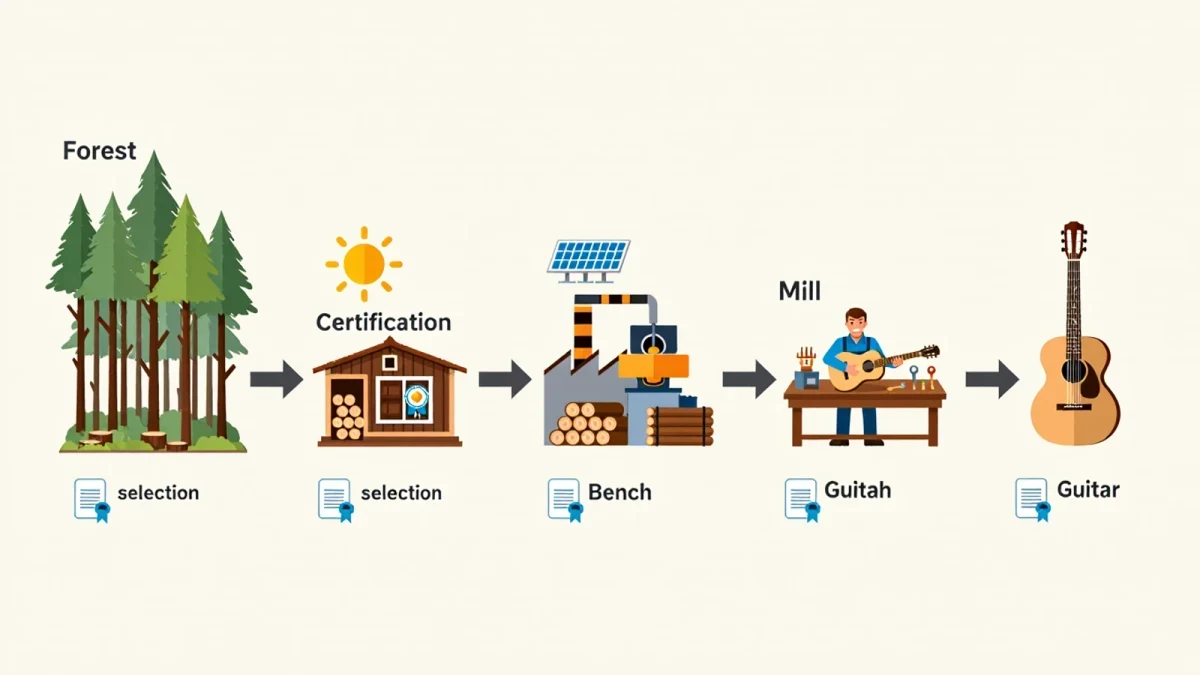
Because wood supply is now a business risk. Acoustic guitars depend on spruce and cedar soundboards, mahogany and rosewood-family bodies, and ebony fingerboards — materials increasingly shaped by international trade rules and certification schemes. Per Martin's sustainability communications, the company has built its program around FSC-certified tonewood, and its Pennsylvania facility runs partly on solar power, as documented on the maker's own site. A summit is the visible version of work that has been running for years: sourcing agreements, certified chains of custody, and substitutes for restricted woods.
What does this change for players?
Three concrete things. Certified-wood models move from marketing story to catalog normal, so buyers will see more FSC-labeled Martins at regular price points rather than only in premium limited runs. Second, familiar specs keep shifting: certified alternatives to traditional tonewoods already appear across the industry, and Martin's push normalizes them further, per the maker's materials. Third, long-term repair and care matter more — a stable supply chain is what keeps bridges, fingerboards, and replacement parts available decades out, which is exactly the horizon a lifetime instrument lives on. It also changes how a buyer reads a spec sheet: certified alternatives and domestic tonewoods are no longer compromises tucked into footnotes but standard materials documented openly by the maker.
What detail did most coverage miss?
The resale connection. Inviting sustainability-minded resale partners into the summit, per Martin's account, quietly frames used instruments as part of the sustainability story: an instrument that stays in circulation for fifty years is the most certified object in the chain. For players, that is a nudge that the secondhand Martin you already own is part of this policy world — and that well-kept used guitars hold their place in a market increasingly organized around certified new wood.