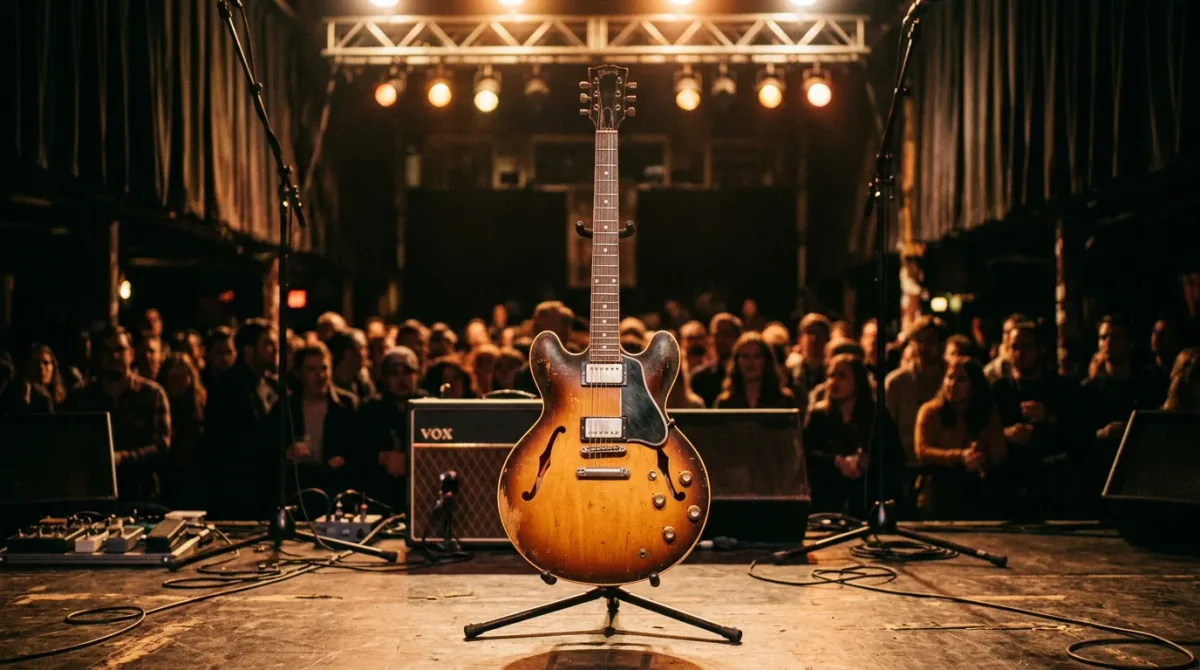
Sister Rosetta Tharpe, inducted into the Rock & Roll Hall of Fame in 2018 under the Musical Influence category, drew 18,000 fans to Griffith Stadium in Washington, D.C. in 1950, filling a ballpark on the strength of her own guitar playing at a time when almost no soloist, male or female, could do that on name alone (Source: NPR, SRC-02).
Tharpe was born Rosetta Nubin on March 20, 1915, and died on October 9, 1973 (Source: Smithsonian, SRC-03). She started playing guitar at age six, accompanying her evangelist mother on the gospel circuit, and spent the next 25 years almost entirely on acoustic instruments before switching to electric guitar around 1947 (Source: NPR, SRC-02). That switch is the hinge her whole reputation turns on: gospel had given her the vocabulary, and the electric guitar gave her the volume to put it in front of arenas instead of churches.
Her technique, as documented by NPR, combined a fingerpicking style built to answer her own vocal lines with fast triplet runs, chromatic movement, and double-stops — playing that held its own against the male guitarists she shared bills with (Source: NPR, SRC-02). She was also a physical performer, reported to play with the guitar held behind her head or while lying down, a showmanship element that predates similar stunts credited to later rock guitarists by decades (Source: NPR, SRC-02).
Instrument-wise, Tharpe worked through several Gibson models across her career, including a Barney Kessel model, an L-5 acoustic, a Les Paul, and an ES-330, before settling on the SG after its release in 1961 for its lighter weight and reworked neck (Source: NPR, SRC-02). The Rock & Roll Hall of Fame lists the Gibson Les Paul Custom as a primary instrument tied to her induction profile, and the Smithsonian's Women's History collection specifically credits her Gibson SG as the instrument on which she delivered what it calls "virtuoso guitar solos" fused with gospel material (Source: Rock & Roll Hall of Fame, SRC-01; Source: Smithsonian, SRC-03).
Commercially, Tharpe was not a niche act. NPR reports she earned roughly $200,000 a year in the late 1940s — equivalent to more than $2 million today — and that her 1951 wedding to Russell Morrison, staged at Griffith Stadium, drew a reported 22,000 paying guests who watched the ceremony as a ticketed event (Source: NPR, SRC-02). In 1938 she became the first performer from the Black Pentecostal tradition to play the Cotton Club, according to the Rock & Roll Hall of Fame's induction materials (Source: Rock & Roll Hall of Fame, SRC-01). In 1957 she toured the United Kingdom at the invitation of bandleader Chris Barber and became an international sensation there, per NPR's reporting (Source: NPR, SRC-02).
The through-line to rock and roll is not a retrospective stretch tacked on by historians — it is attributed directly to the musicians she influenced. NPR quotes Chuck Berry saying his career amounted to "just one long Rosetta Tharpe impersonation," and cites Bob Dylan's observation that young English guitarists picked up the electric guitar after seeing her play (Source: NPR, SRC-02). Brittany Howard of Alabama Shakes, who inducted Tharpe into the Rock & Roll Hall of Fame, is quoted by the Hall of Fame itself describing her as bringing "a powerhouse voice and groundbreaking guitar technique" to the stage (Source: Rock & Roll Hall of Fame, SRC-01).
What separates Tharpe's documented record from a simple influence-chain narrative is how consistently the sourcing lands on the guitar itself rather than just her voice or persona. The Smithsonian's account describes her work as combining "traditional gospel music with virtuoso guitar solos on her Gibson SG," language that treats the instrument as the mechanism of the innovation, not a prop around a vocal performance (Source: Smithsonian, SRC-03). For guitarists studying her catalog today, the pairing to listen for is the one the sources keep returning to: a fingerstyle attack developed in church, run through an amplifier, and aimed at rooms built for thousands rather than pews built for dozens.
She often performed as a solo accompanist without a backing band, a detail NPR notes as part of what made her guitar playing — rather than an ensemble sound — the focal point of her shows (Source: NPR, SRC-02). That configuration put technical weight squarely on her hands, in performances that predate the electric-guitar-as-lead-voice format later associated with rock's first generation of stars.
The Rock & Roll Hall of Fame's own framing of her induction places her in the Musical Influence category rather than the standard Performer category, a distinction the institution reserves for figures whose impact on the genre's development is judged to outweigh a conventional chart-hits resume (Source: Rock & Roll Hall of Fame, SRC-01). Read alongside NPR's account of her earnings, touring draw, and the guitarists who cited her directly, that categorization tracks with a career built less on radio ubiquity than on musicians in the room watching how she played (Source: NPR, SRC-02).
For players working through her catalog now, the documented record suggests a specific listening approach: start with the acoustic-era recordings from before 1947 to hear the fingerpicked, church-honed vocabulary, then move to the electric material to hear how she translated that same vocabulary, the triplet runs, the double-stops, the chromatic passing tones NPR describes, into a louder, more physical register once she had an amplifier under her (Source: NPR, SRC-02). The Smithsonian's framing of her as combining traditional gospel music with virtuoso guitar solos is, in effect, a description of that same translation, not two separate skill sets but one vocabulary carried across two eras of the instrument (Source: Smithsonian, SRC-03).
For a related music news perspective, read Ben Affleck and Matt Damon Make a Splash on Gossip Stone TV.
For more context, read How Often Should You Change Your Strings? The Honest Answer.