Brian May, born in Hampton Hill, London, on July 19, 1947, plays one of the most famous home-built instruments in rock. The Red Special — constructed with his father Harold, largely from the oak of a discarded fireplace mantel — has been his main guitar through every era of Queen, from the band's 1970s rise to his knighthood in March 2023, which the BBC reported after the ceremony at Buckingham Palace. Builders and players study the guitar because its documented design choices do things off-the-shelf instruments do not.
How was the Red Special built?
The documented account, repeated in May's own published descriptions of the project: around 1963, the teenage May and his father, an electronics engineer, could not afford a good electric guitar, so they built one. The wood came from an oak fireplace mantel salvaged from a house being renovated — old, dry, dense oak that most builders would reject as too hard to work. The body was made as a semi-acoustic sandwich around a void, giving resonance without feedback-prone depth; the neck was shaped with hand tools over many months. The pickups were wound by a friend; later versions of the design, as sold today in licensed form, use copies of the Burns Tri-Sonic units the guitar eventually carried. A zero fret and a 24-fret board gave the instrument full range and consistent open-string tone at every position, per the design as described by May.
What about the coin instead of a pick?
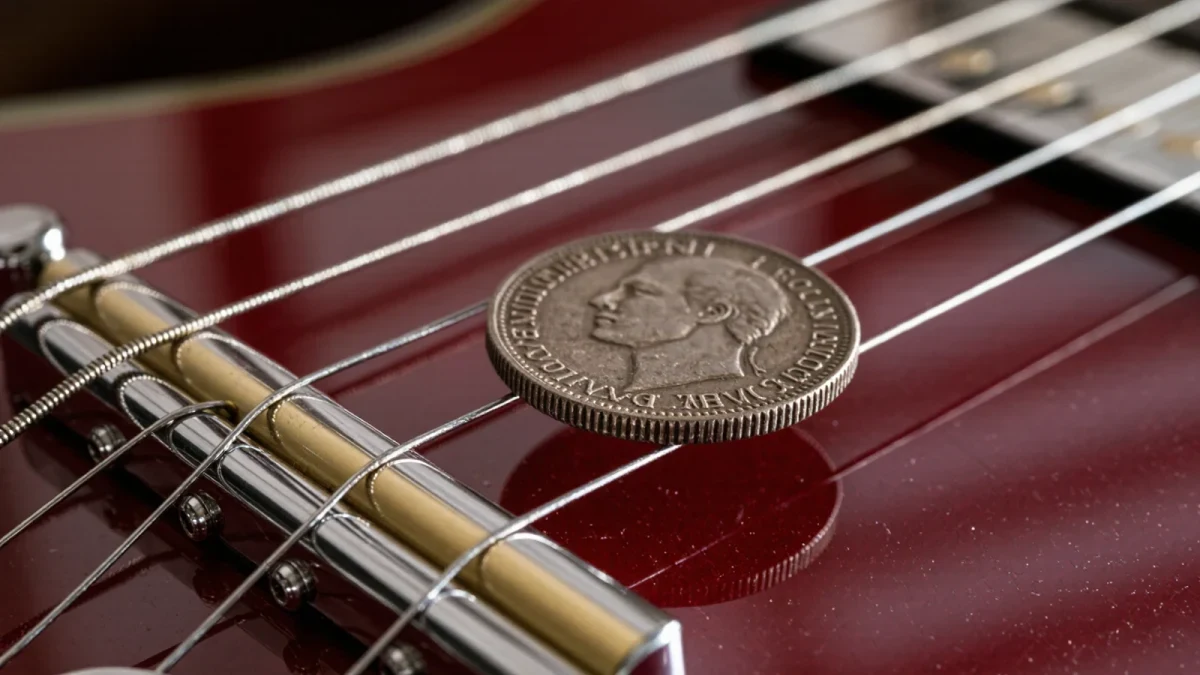
May plays with a sixpence — a pre-decimal British coin — instead of a plectrum, a habit documented in his interviews across five decades. The reason is mechanical: the coin's milled edge lets him contact the strings with a hard, narrow surface at a precise angle, which contributes to the articulation of his fast triplet runs, and it never wears down like nylon. Any player can test the principle with any hard, smooth-edged coin; whether it suits a given right hand is another matter entirely. The coin is the cheapest documented tone secret in rock, and it comes with a warning label from every guitar teacher who has watched a student gouge a soundboard with one.
What can builders take from the design?
Three documented ideas. First, the semi-hollow oak body: heavy, dense timber plus an internal chamber produces a sustaining, vocal quality that May's own accounts connect to the wood's age and dryness. Second, the electronics: three pickups with individual on-off and series-phase switching, per the wiring as described by May, give more usable combinations than a standard three-way — including the out-of-phase tones heard on Queen records. Third, the zero fret, which makes the open string sound like a fretted note and is common on the guitars May's licensed reproductions follow. None of these require exotic materials; they require decisions, made early, by someone who understood the instrument as a system.
How do you get one, on the documented record?
May's own signature instruments are sold under license through Brian May Guitars, whose catalog lists affordable reproductions of the Red Special design as well as amplifier offerings connected to his stage sound. Prices for the entry reproductions have generally sat in the student-instrument band rather than the boutique tier, per the company's listings as of 2025 — buyers should verify current pricing at the point of sale, since prices move. The original guitar, it should go without saying, is not for sale; it remains May's working instrument, and he has described repairing it himself, including after incidents on tour documented in his published accounts.
What did the guitar actually do on the records?
Two documented signature effects. The first is the layered harmony solo — May overdubbed his own lines in stacked thirds and fifths to build what he has called guitar orchestras, most famously on Bohemian Rhapsody and the solo of Brighton Rock, which grew from a live improvisation into a multi-part studio construction. The Red Special's sustaining, chambered voice was suited to the job: the notes hold pitch and tone long enough to layer cleanly. The second is the two-amps live approach of his Queen-era stage rig, which his published gear accounts describe as running delays in stereo to recreate the layered sound in real time. Neither trick requires his guitar — they require patience and a plan — but both sound like they were designed around an instrument that rings longer than a standard solidbody.
Why does the story matter beyond Queen?
Because it reframes what a student instrument is. The Red Special was built by two people with hand tools, salvage wood, and a clear design brief, and it outperformed instruments costing real money in 1963 — then carried a Hall of Fame catalog of recordings. May also finished, decades later, the astrophysics doctorate he set aside when Queen took off, receiving his PhD from Imperial College London in 2007 per the university's records, and was knighted in 2023 for services to music and charity, per the BBC. The guitar lesson and the life lesson run the same direction: constraints plus patience beat budget plus impatience.