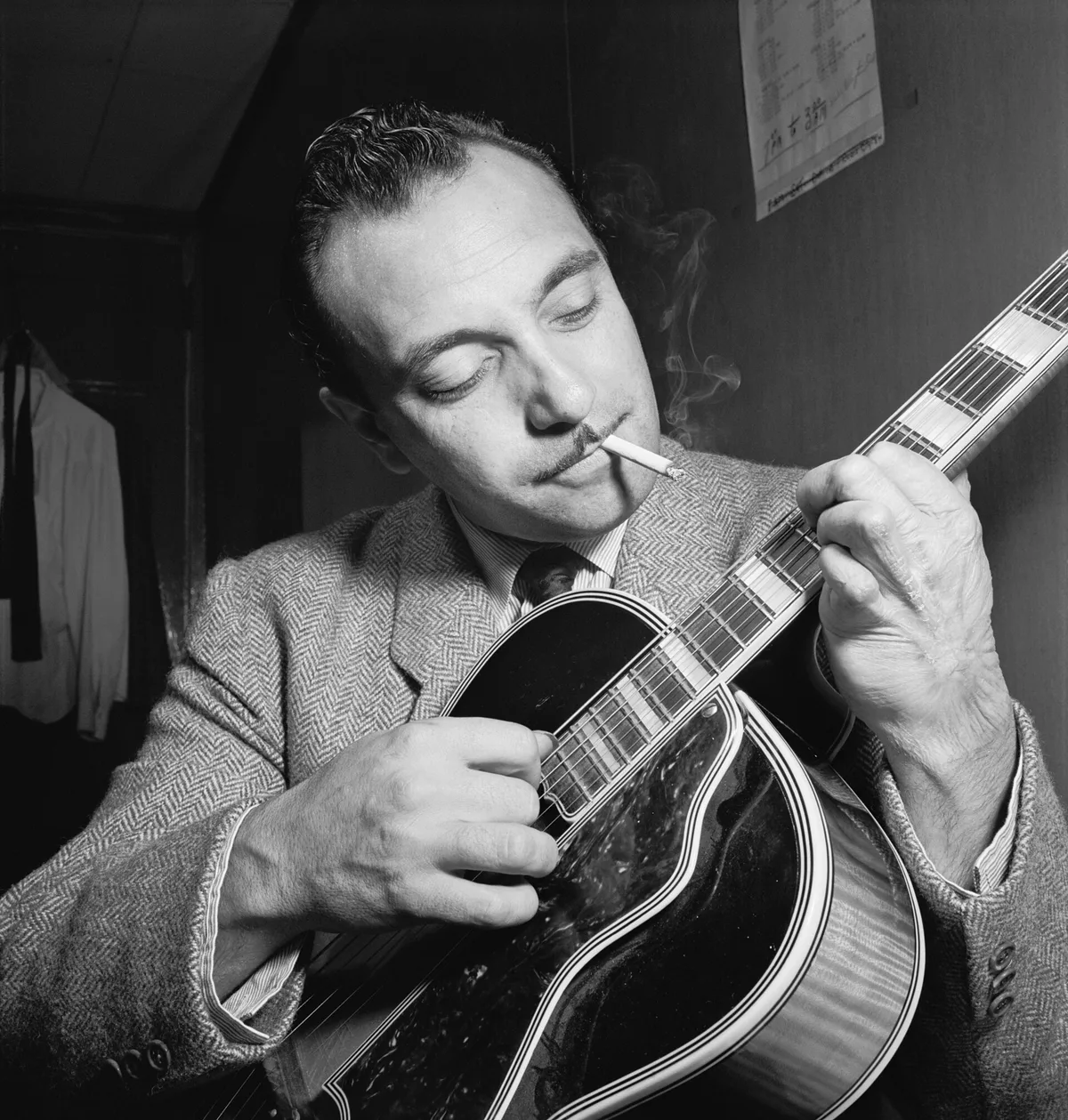
Few guitarists have ever sounded as urgent as Django Reinhardt. He was one of the first major jazz talents to emerge in Europe, and the style he helped found, gypsy jazz, still copies his attack today. The secret was never only his left hand. It was what his right hand did with a pick.
This guide walks through the habits behind that sound. Some came from the Paris dance halls where he learned his trade. Others grew out of a terrible accident that forced him to rebuild his playing from scratch. All of them can be studied by any guitarist with a pick and patience. We covered a connected angle in Nylon vs Phosphor Bronze Strings: Sound and Feel Trade-Offs.
A Fire That Rebuilt His Hands
The turning point came in November 1928. Reinhardt knocked over a candle in his caravan wagon, and the flames left him with burns over half his body, according to his Wikipedia biography. Doctors feared he would never play guitar again. The ring and little fingers of his left hand were badly damaged, so he taught himself to play again using mainly his index and middle fingers.
That injury shaped everything that followed. He built a new system around three-note chords, each one able to stand in for several conventional chords in different positions. In fast melodic runs he played arpeggios with two notes per string while moving up and down the neck, rather than staying in one fixed spot. What listeners hear as effortless swagger was a workaround turned into a signature.
The Pick Comes First
Reinhardt played mainly with a plectrum rather than his fingers. Amplification in the dance halls of the 1920s and early 1930s barely existed, so he relied on the pick for maximum volume and attack, even though he could also play fingerstyle on occasion. A heavy, committed stroke was the price of being heard over an accordion and a noisy room. That habit never left his playing, even after amplifiers arrived.
La Pompe, the Engine of the Style
Rhythm guitar in this music is called la pompe, the pump. According to the Wikipedia overview of gypsy jazz, the strumming hand makes a quick up-down stroke followed by a down stroke, and the pattern leans hardest on beats two and four. The technique is percussive enough to replace a drummer, which mattered because the original Quintette worked without one. The up-down part must be fast at any tempo, and that is what gives the music its pushing, swinging feel.
Fast Lines, Down Strokes and Slides
The solo vocabulary leans on the same economy. Notes on one string alternate, but when a line moves to a new string, players traditionally use a down stroke, a habit chosen for volume and tone. Chromatic runs race across wide stretches of the neck, and a characteristic glissando slides a finger along the string while the picking hand spells out a tremolo. Diminished runs, the same shape played through every inversion, remain a calling card of the style. For related coverage, see Fingerstyle vs Flatpick: Technique, Tone, and When to Use Each.
The Quintette and Its Sound
In 1934 Reinhardt joined violinist Stephane Grappelli in the Quintette du Hot Club de France, a Paris group famous for putting the guitar in the lead seat. Most players in the style still favor the Selmer-Maccaferri design he used, and later models carried a smaller O-shaped sound hole. The music aims for an acoustic sound even on amplified stages. Tunes like "Minor Swing" and "Nuages" have become standards that every gypsy jazz player learns.
Borrowing the Attack Today
You do not need Reinhardt's background to learn from his method. Start with la pompe at a slow tempo, snapping the up-down stroke as one motion, and let a metronome stand in for the drummer you do not have. Then practice arpeggio shapes that travel along the neck on pairs of strings. Finally, learn one solo by ear, the way Reinhardt himself worked, since he played completely by ear and could neither read nor write music.
Conclusion
Django Reinhardt's right hand turned limitation into a language. A picked attack built for loud rooms, a percussive la pompe that replaced the drummer, and solos that race through arpeggios and diminished shapes all came from one man rebuilding himself after disaster. Take those habits one at a time, and the sound of gypsy jazz starts to make sense, one down stroke at a time.