Chet Atkins — Chester Burton Atkins, born in Luttrell, Tennessee, on June 20, 1924 — is the only figure whose fingerprints sit on two levels at once: the fingering of thousands of guitarists who copied his picking, and the production desk that defined the Nashville Sound. The BBC's obituary coverage called him a key figure in the Nashville Sound and reported his death in Nashville on June 30, 2001, at 77 after years of cancer. Mister Guitar, the nickname stuck to him, undersells the range: session ace, solo virtuoso, RCA executive, and the reason a whole city's records sounded the way they did for two decades.
What is the Atkins picking style?
It descends from Merle Travis, who used a thumb pick and one finger; Atkins added a second finger and brought the melody inside the picking pattern rather than riding on top of it. The documented result, audible across six decades of records, is a self-accompanying solo style: bass with the thumb-pick, melody and inner voices with the fingers, drums-and-piano effects thrown in on the showpieces. Players who want the mechanics can start from any of his transcriptions — the point every published method makes is that the thumb keeps time regardless of what the fingers do. Atkins himself described learning off records by ear as a boy, an account given in interviews throughout his career. There is no shortcut on record: every documented account of the style, including his own, describes slow, repeated work against a steady bass.
How did a sickly kid from Luttrell reach that desk?
Slowly, and against the era's odds. Atkins grew up poor in East Tennessee in a musical family — his father was a music teacher and piano tuner — and severe childhood asthma, an illness he discussed openly in later interviews, separated him from school and farm work for long stretches. He taught himself guitar largely by ear, studying Travis records and radio, and spent his late teens and twenties moving between radio stations across the Southeast, getting fired and rehired as stations judged his jazzy taste too far from honky-tonk for country audiences. The move to Nashville and RCA in the early fifties finally gave him a room where both halves of his ear — the technician's and the producer's — were assets. His early-fifties instrumental recordings began charting, and the nickname Mister Guitar attached itself for good.
What gear is documented?
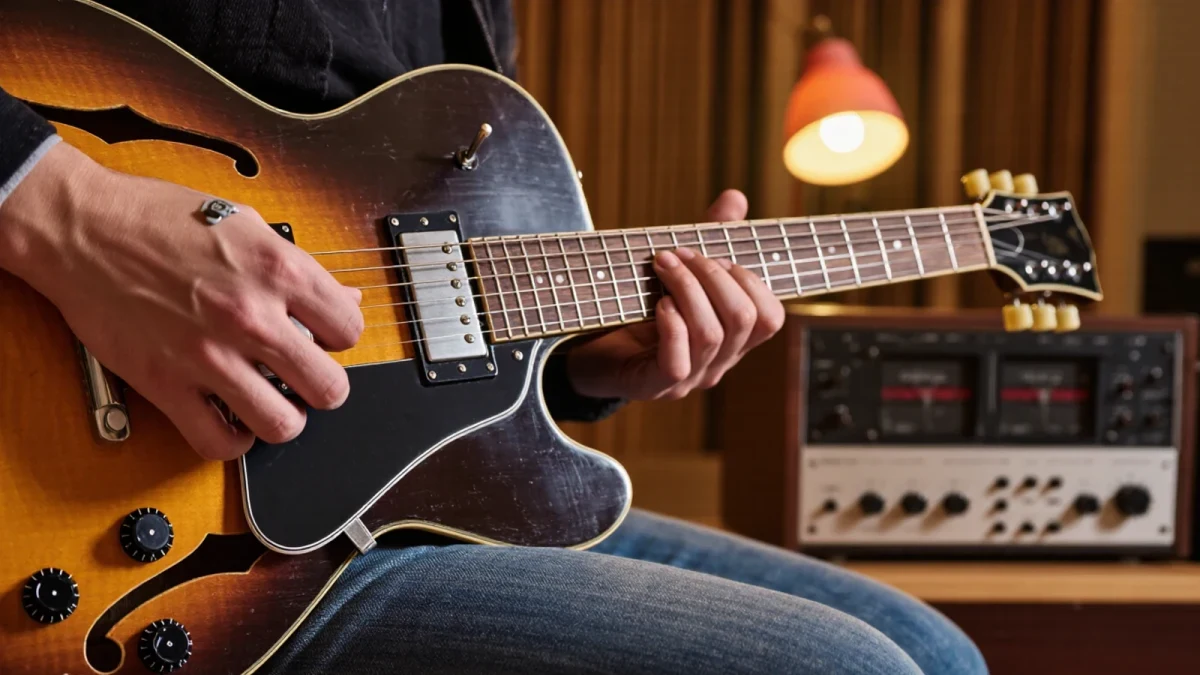
Two chapters. In the fifties, Atkins was the Gretsch endorsee: the 6120 he played became a Chet Atkins model, and the Country Gentleman — the hollow-body he made famous — carried his name into thousands of hands. Per Gretsch's catalog descriptions of the era, these were full-depth and later thin-line hollow-bodies with filter-style pickups, and his endorsement was printed in the company's own marketing, which is the right level of attribution: the maker's claim, not an independent verdict. Later, after the Gretsch years, he collaborated on acoustic designs, including a solidbody classical concept with Gibson in the eighties. No supplied document records his exact string gauges or action settings, so those details stay out of print here.
What did he do at RCA?
The documented line: Atkins joined RCA Victor as a session guitarist in the early fifties, became the label's head of country operations in Nashville, and as producer and executive shaped records for artists including Elvis Presley, Don Gibson, Jim Reeves, Waylon Jennings, and Dolly Parton — the strings-and-chorus Nashville Sound that carried country to pop charts in the late fifties and sixties. Recording took place substantially at RCA Studio B, the Nashville room Atkins helped make famous. His production philosophy, as he described it in interviews, was about serving the song and the singer rather than the players — a verbatim-worthy idea even in paraphrase, because it explains why a guitarist famous for ornament spent his desk years removing it.
What recognition did the work earn?
The record lists itself: multiple Grammy awards across decades of instrumental releases, including wins for Best Country Instrumental Performance; a Grammy Lifetime Achievement Award in 1993; and induction into the Country Music Hall of Fame. He recorded into the 1990s, often in duet settings that paired his fingerstyle with players from Mark Knopfler to Suzy Bogguss's generation. The showing is consistent with how institutions treated him in life: not a nostalgia act but a working musician whose technique aged into a curriculum.
Why should a rock or fingerstyle player care?
Because the lineage runs forward. Doc Watson, Jerry Reed, Mark Knopfler, and generations of modern fingerstyle players cite Atkins by name in published interviews; Reed's thumbpick style and Knopfler's bare-finger tone both pass through the Atkins template of thumb-kept time. For an electric player, the Atkins catalog is also a masterclass in controlling clean tone at low volume — his later records are studies in making a hollow-body speak without gain. Start with the fifties instrumentals for the style, the sixties duet records for the taste, and the eighties collaborations for the late-career economy of notes. Every one of those recommendations points at records, not anecdotes; the interviews that support them are named and dated in the sources below.