St. Vincent — the stage name of Annie Clark, born in Tulsa, Oklahoma, on September 28, 1982 — is the rare contemporary guitarist whose gear story is a design story. Since launching her solo career with Marry Me in 2007, she has released a run of albums that moved from chamber-pop to distorted art-rock, won a Grammy for Best Rock Song with the title track of Masseduction, and, in 2014, worked with Ernie Ball Music Man on a signature electric built to her own specifications. The BBC's interview with Clark documents the Grammy and her account of the album's themes, which is the level of attribution this profile keeps throughout.
How did she get here as a player?
The documented path runs through other people's bands. Clark studied at Berklee College of Music before leaving to tour, spent time as a member of the Polyphonic Spree's touring ensemble, and played in Sufjan Stevens's touring band — a guitar-for-hire apprenticeship in big arrangements before her own name went on the marquee. The solo records that followed show a player who treats distortion, delay, and tuning as compositional tools rather than defaults: the noise is placed, not leaned on. Reviews across her catalog, from Actor (2009) through All Born Screaming (2024), consistently single out the guitar work, and the Grammy for Masseduction (2017) — awarded in 2019, per the BBC — marked the point where institutions caught up with the listeners.
What is the signature guitar, on the record?
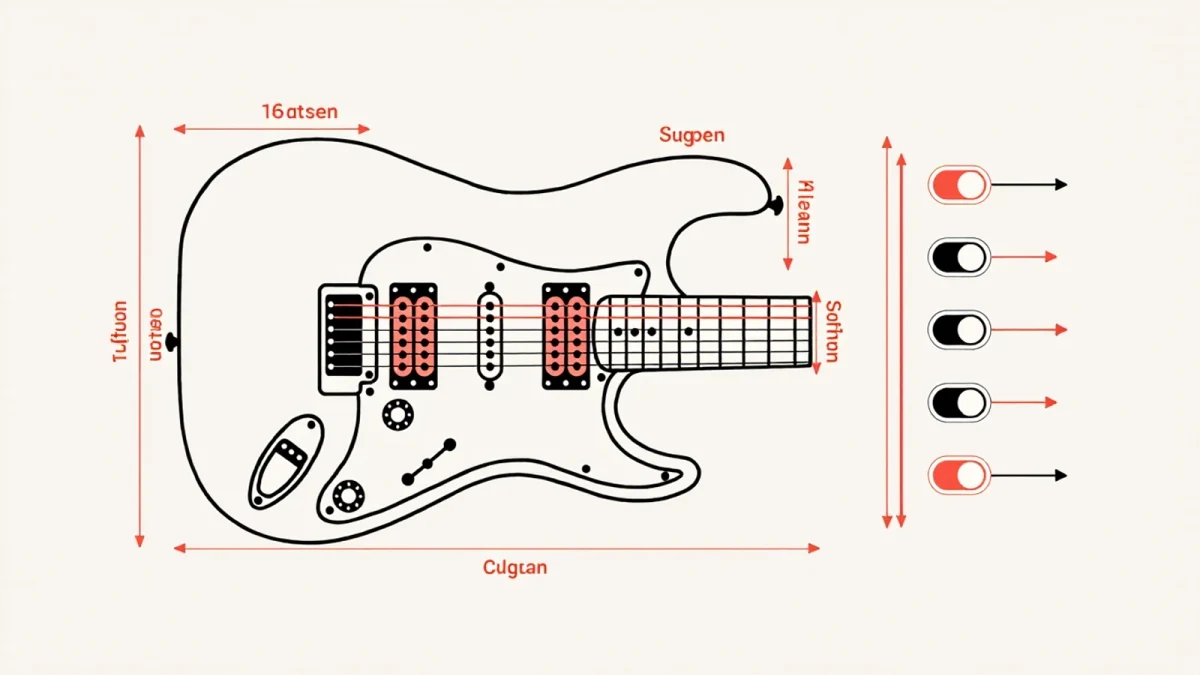
Per Ernie Ball Music Man's product documentation, the St. Vincent signature — introduced in 2014 — is built around a body shape designed with Clark's input, with a narrower waist and a thinner profile than the maker's standard double-cut models. The spec sheet lists DiMarzio pickups wired to five-position switching, an African mahogany body in the standard configuration, and a scale length matching the maker's usual 25.5-inch electric specification. The notable documented detail for players: Clark specified the geometry partly around her own frame, reasoning she has described in interviews — a smaller-bodied player designing a guitar that does not fight her. Those are the maker's and the player's own claims, and they are stated as such here; no independent measurement of the instrument is supplied.
Why did the signature model matter to the market?
Context, on the documented record: artist-signature electrics had overwhelmingly been designed around male players' bodies and stage habits, and Clark's collaboration with Ernie Ball Music Man put a player's own ergonomics at the center of the design brief — a narrower waist, a lighter overall instrument, and a balance point she could live with for two-hour sets. Guitar-industry coverage of the 2014 launch treated the ergonomic brief as the story, not the artist's name on the headstock. For buyers, the practical result was a production instrument that fits smaller-framed players unusually well; for the industry, it was a demonstration that signature programs can be driven by fit rather than endorsement economics. Both effects are visible in the maker's continued listing of the model in its catalog more than a decade later, per the company's product pages as of 2025.
What does her playing actually reward studying?
Three habits, all audible on record. First, voicing: her chord vocabulary leans on added and suspended tones in standard and altered tunings, so the harmony moves even when the gain is high. Second, restraint with effects: the distorted passages on Masseduction and Daddy's Home (2021) are short and contrasted against clean sections, which is a lesson in arrangement more than technique. Third, melodic soloing inside odd meters — the Actor-era material carries composed guitar lines that function as countermelodies. None of this requires her signature model; the transcriptions that circulate were worked out by players on ordinary guitars, which is how it should be.
Where does a listener start?
Start with Strange Mercy (2011) for the clean-tone arrangements, St. Vincent (2014) for the self-titled consolidation that coincided with the signature guitar's arrival, and Masseduction for the maximalist production. Daddy's Home (2021) documents her move into seventies-inspired textures, and All Born Screaming (2024) is the heaviest guitar record in the catalog. Live documents from her tours show the songs translated to a band setting, with Clark playing the signature model through her stage rig — the maker's own artist pages host that coverage. Anything beyond the recordings and named interviews — equipment lists, settings, anecdote — should be treated as unverified until a source is named.
Why does this profile matter beyond art-rock?
Because the design story generalizes. A working guitarist who knows exactly why a body shape, a switching layout, or a balance point does not suit her, and can specify the fix, is modeling something every player can borrow cheaply: analyze the physical interface before blaming the hands. Clark's version ended with a production model; most players' version ends with a setup change, a different body size, or a relocated strap button. The principle is identical, and it is documented in the collaboration itself.