Agustín Barrios (1885-1944) was a Paraguayan guitarist and composer who wrote more than three hundred works for the instrument, and his pieces — above all 'La Catedral,' 'Una Limosna por el Amor de Dios,' and the waltzes of 'Mangoré' fame — now sit near the core of the classical guitar repertoire. He spent decades touring Latin America and Europe, performed in the persona of a Guaraní chief he named Nitsuga Mangoré (Nitsuga being Agustín reversed), and died in El Salvador in 1944 with his music largely out of print. Rediscovery came slowly, driven by recordings and the advocacy of later players, until today no serious concert program treats his music as a rarity.
Where did Barrios come from?
Barrios was born in San Juan Bautista de las Misiones, Paraguay, in 1885, into a family with money problems that his biographers document as chronic. He learned guitar and later theory and composition in Asunción, where he also studied the works of the standard European canon; his compositions quote Bach openly — the third movement of 'La Catedral' is subtitled an allegro solemne and the whole suite reflects a Bach-inspired religiosity he made no effort to hide. From early on he was both a virtuoso player and a working popular musician, an overlap that shaped everything he wrote.
What was the Mangoré persona?
In the 1930s Barrios began appearing in concerts — at least for a period — dressed in Guaraní-inspired costume as 'Nitsuga Mangoré, the Paganini of the guitar from the jungles of Paraguay.' Theatrical presentation was a common promotional device of the era, and his biographers disagree on how long he kept the costume; the nickname Mangoré stayed with him regardless, appearing on programs and in his signed photographs. The stagecraft is easy to smile at, but it booked halls in cities that had never heard a Paraguayan guitarist, and the music underneath required no costume.
How far did his career reach?
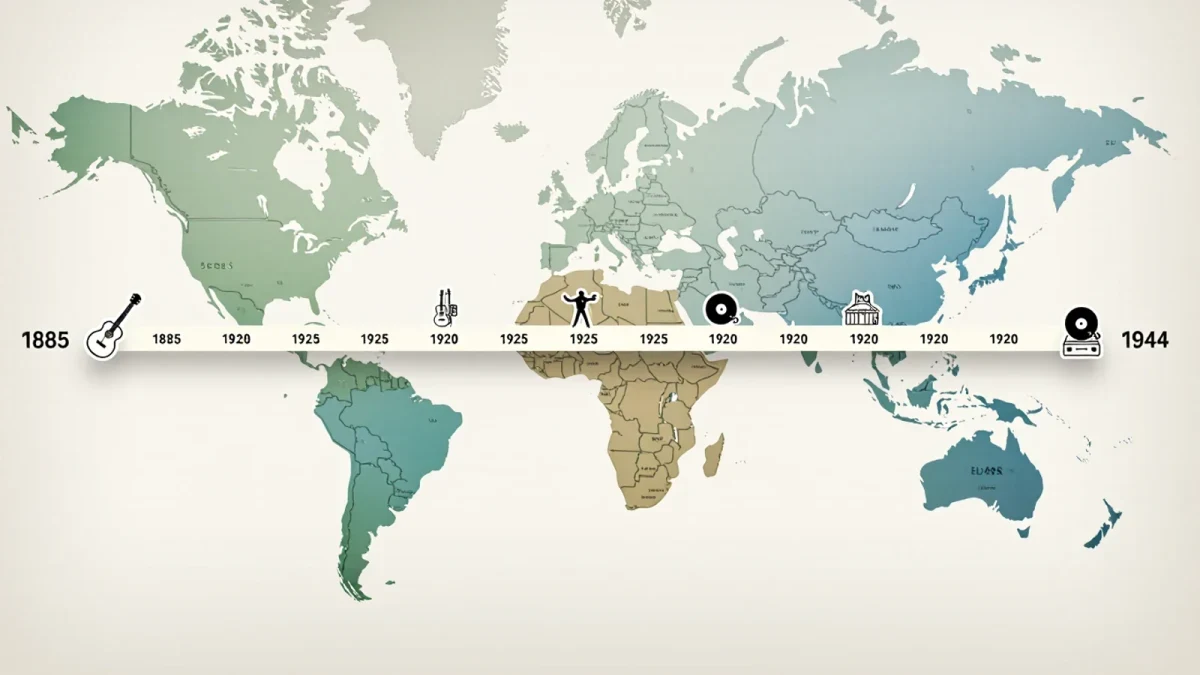
Documentation places him performing across Argentina, Uruguay, Brazil, Chile, and later Mexico, Central America, and the Caribbean; he reached Europe in the mid-1930s, touring Belgium, Spain, and other countries, where reviewers compared him favorably to the established virtuosos. He made recordings for several labels between the 1910s and the late 1920s, and those shellac sides — over thirty works survive — later became the evidence that forced his rediscovery. He spent his final years teaching and performing in El Salvador, where he died in August 1944. Two things he never achieved in life: publication of his works in a collected edition and a stable home; he spent most of his career as a touring musician with, per his biographers, little business sense and chronic money trouble.
Why did his music nearly disappear?
Barrios published little during his lifetime, and most of his works circulated in manuscript, in his own arrangements, or not at all. After his death the repertoire's gatekeepers — centered in Europe — favored a narrower Spanish canon, and Paraguay had no publishing infrastructure to press his case. The recovery took two threads: the circulation of his recordings, and players who took the pieces up. By the 1970s, editions of major works began appearing, and by now virtually the entire catalog is in print across multiple editions, with manuscript variants a live scholarly question.
What should a player start with?
'La Catedral' is the summit — a three-movement suite whose outer movements bookend a serene andantino, playable in parts by intermediates and as a whole considered a concert benchmark. The waltzes (Nos. 3 and 4 are the popular entries) sit lower, as do the 'Canción de la Hilandera' and the tremolo showpiece 'Una Limosna por el Amor de Dios' — that last one, composed shortly before his death, remains among the most-played tremolo pieces in the repertoire. His music's signature is the fusion: European romantic and baroque forms carrying South American melody, rhythm, and folk idiom without either side dressing up as the other.
Technically, his writing rewards exactly the skills classical training builds: sustained melody over independent bass, shifts across positions that follow the phrase rather than the fingering, and rhythm sections borrowed from Paraguayan polka and Argentine dances that ask for a light, dancing right hand. Students often meet him first through the waltzes and stay for the suites; the music grows with the player for years, which is part of why it held on until the world caught up.
What did Barrios leave the guitar?
A repertoire that made the instrument's map bigger. Before his rediscovery, the classical guitar's central canon was largely Spanish and centered on a handful of names; Barrios proved the instrument had a deep Latin American literature of concert quality. Every player who learns 'La Catedral' is working through that argument.
What the sources do not establish: exact catalog counts vary by scholarship (over three hundred works is the commonly cited figure), dates for individual compositions are frequently uncertain, and the duration of the Mangoré costume period is disputed among biographers. This profile draws on published biographical research and the recordings themselves; no quotations are invented.