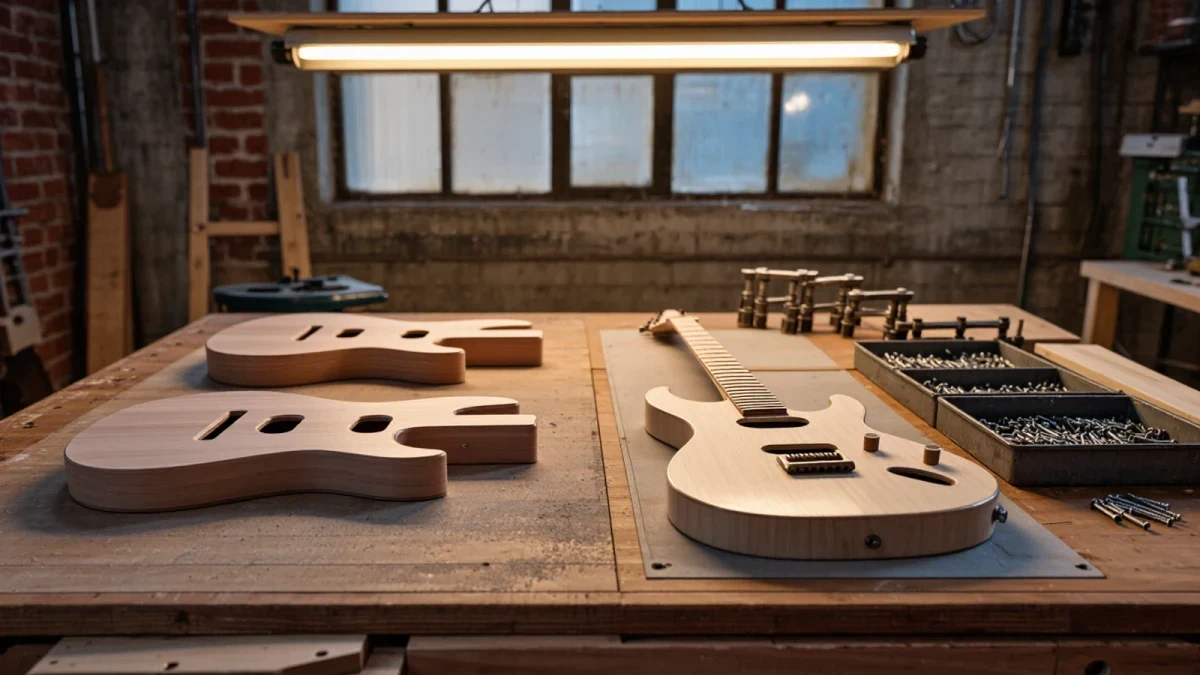
Bolt-on, set, and neck-through are the three ways an electric guitar's neck meets its body: a bolt-on neck is screwed to the body with four screws and a metal plate (Fender's standard), a set neck is glued into a pocket (Gibson's standard), and a neck-through runs one continuous piece of wood through the entire body with wings glued to its sides. All three approaches ship on current production guitars from under $200 to over $4,000, per maker spec sheets — the join method is engineering, not a quality tier.
This explainer is built from maker documentation and published repair references. No claim below is a hands-on verdict, and sustain numbers are exactly as sourced: makers claim differences; nobody supplied a controlled measurement.
How does each joint actually work?
The bolt-on is literal: the neck's heel sits in a routed pocket and four machine screws clamp it against a metal neck plate, a design Fender standardized on its 1950s solidbodies — instruments whose rise BBC Future documented in its history of the electric guitar's breakthrough decades. The set neck uses hide or modern glue in a tapered pocket, the dominant acoustic-guitar method and Gibson's electric standard since the 1950s. Neck-through construction laminates strips into a single shaft that runs the body's full length, with the body built up from glued wings — documented on Rickenbacker models since the 1950s and on many basses and high-end solidbodies since.
Which construction sustains best?
The maker-claimed ranking runs bolt-on, then set, then neck-through, with neck-through marketed on maximum coupling between string anchors. The physics argument, as makers and luthiers frame it: more continuous mass and glue surface between the nut and the bridge transfers more string energy into the body.
What the sources do not establish is an audible, controlled difference of practical significance. No supplied published test measures sustain across the three joints with other variables held equal — pickup output, body mass, and string gauge each move sustain more than any honest joint comparison can isolate. Treat sustain ordering as a maker claim with a plausible mechanism, not a verified fact.
What about attack and tone?
The documented shorthand, from maker marketing and luthier interviews, gives bolt-ons a snappier attack and set necks a described "warmer," smoother response, with neck-throughs described as most even-sounding and piano-like. These are claims about energy transfer at the joint, and every one is framed in maker language on this page rather than tested. What is structurally true: a bolt-on's metal-screw coupling is a stiffer, more localized joint than a long glue line, and that mechanical difference is the entire basis of the tone debate.
Which is easiest to repair and adjust?
This is where the engineering is least debatable, per published repair references. A bolt-on neck comes off with a screwdriver — shimming a pocket, adjusting the neck angle, or replacing the neck entirely are bench-level jobs, and replacement necks are a documented aftermarket category. A set neck requires steaming or cutting to remove, making resets expensive, structured jobs. A neck-through neck cannot be replaced at all; fret-leveling and surface repairs are possible, but a twisted neck-through shaft usually means the guitar is done.
That asymmetry shows up in long-term ownership cost more than in any tone chart. It also explains why working players' backup guitars skew bolt-on: a broken neck on tour is a swap, not a restoration project.
How does the joint affect high-fret access?
Neck-through and well-carved set necks typically offer smoother access to the upper frets, because there is no bulky heel or plate at the joint — a design point makers emphasize on neck-through shredders and carved-heel set-neck models. Vintage-style bolt-ons with full-size heels are the most obstructed. Modern bolt-ons with contoured or sculpted heels close much of that gap while keeping the serviceability, per current Fender and Ibanez spec sheets that list contoured heels as features.
Does the joint affect tuning stability?
Only indirectly. Tuning stability lives at the nut, the tuners, and the tremolo system, not at the neck joint itself. What the joint can affect is rigidity under string tension over years: a loose or worn bolt-on pocket shifts neck angle gradually and shows up as changing relief, which players sometimes misread as a tuning problem. Published setup references list checking neck-pocket tightness among standard diagnostics for bolt-ons, while set and neck-through joints fail differently — through glue-line movement, which is rare and expensive when it happens. The practical takeaway: a stable neck joint is a baseline every construction method meets when built well, and no joint type buys you out of maintaining nut and tuner hardware.
Which construction should you buy?
- You tour, tinker, or want cheap maintainability — bolt-on. Serviceability is structural, not marketing.
- You want traditional Les Paul-style feel or play mostly acoustic — set neck, the standard for that design language.
- You want maximum upper-fret access and don't plan major repairs — neck-through, common on basses and modern soloist shapes.
On the supplied evidence, the joint method should be a tiebreaker, not a headline criterion: body design, pickups, and setup move more of what you hear. But between two otherwise equal guitars, the bolt-on's repair math is the one documented advantage no marketing claim needs to support.