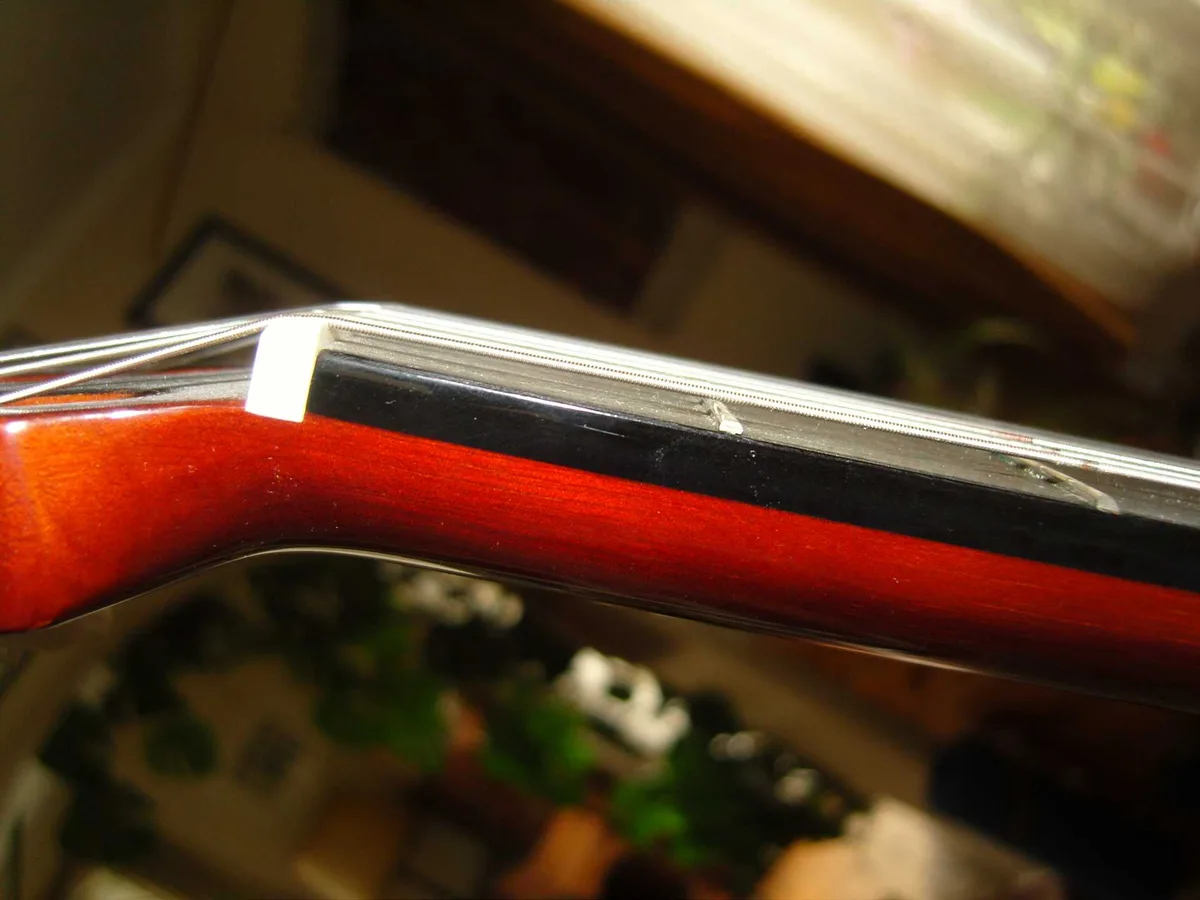
You tune up carefully. The open chords ring clean. Then you climb past the third fret and everything turns sour — a solo up the neck sounds like a different, worse guitar. That is an intonation problem, and it is one of the most common reasons a perfectly good guitar gets blamed for a fault it does not own.
Guitar intonation is the accuracy of pitch as you move up the fingerboard. Each fret should raise the string by one exact step. When the string's speaking length is even slightly wrong for its gauge and tension, the fretted notes land sharp or flat, and the error grows as you climb. The open string can be perfectly in tune while the twelfth fret is badly out. Both things are true at once, which is why tuning alone never fixes it.
A note on the word itself: in speech, intonation means the rise and fall of pitch — Cambridge Dictionary defines it as the way the voice's pitch changes to carry meaning. A guitar's intonation borrows the idea of pitch accuracy, but the mechanical cause is physical, not expressive. The string is either the right length for the pitch it must produce, or it is not.
Why does a guitar go out of tune up the neck?
When you press a string down at a fret, you stretch it. That stretch raises the pitch a little, and the bridge saddle has to be positioned to compensate — moved back to lengthen the string just enough to cancel the sharping. If the saddle sits in the wrong place, every fretted note above it drifts. The drift is small near the nut and larger near the octave, which is exactly why the trouble shows up past the third fret and worst at the twelfth.
Several things push a once-correct setup out of true. String gauge changes are the big one: switch from lights to mediums, or even between brands, and the amount a string stretches under your finger changes with it. Action height matters too — raise the strings and you press them further down to fret, stretching them more. Old strings stretch unpredictably and can intonate badly even when the saddle is right. Neck relief, fret wear, and on acoustic instruments, seasonal wood movement all shift the geometry as well; humidity swings that move the top and neck are the same force covered in our guide to the right humidity for an acoustic guitar.
Temperature plays a part as well. A guitar that intonates fine in a warm shop can drift after an hour in a cold venue, because metal saddles, steel strings, and wood all move at different rates. None of this means the guitar is broken. It means the compensation is a moving target, and it is worth checking from time to time.
How do you check intonation in ten minutes?
The standard check compares a fretted note against its harmonic at the twelfth fret. A harmonic is a bell-like tone you get by touching the string lightly over a fret rather than pressing down. Because a harmonic involves no fretting stretch, it gives you the string's true octave. The fretted twelfth-fret note includes the stretch. If the two disagree, the compensation is off.
- Tune the open string precisely, with a good tuner.
- Play the harmonic at the twelfth fret and note what the tuner reads.
- Fret the string at the twelfth fret, pick it the same way, and read again.
- If the fretted note is sharp, the string is effectively too short — the saddle needs to move back, away from the neck. If it is flat, the saddle needs to move toward the neck.
- Retune the open string after every adjustment, then repeat the comparison.
Repeat for each string. Work in small steps — a turn or two of the screw at a time — and retune between checks. The open string and the octave interact, so chasing one without retuning sends you in circles. That is the whole method. It tells you whether the guitar is the problem or the setup is.
How do you adjust intonation at the bridge?
On most electric guitars, each string has its own adjustable saddle — a small barrel or blade set on screws. Turn the screw and the saddle slides back or forward. Sharp at the twelfth means turn the screw so the saddle moves back; flat means it moves forward. On a typical Telecaster-style bridge, each saddle is held by screws accessible from the back of the plate. On most Fender-style and Gibson-style electrics the principle is identical, only the screw location differs.
Acoustic guitars are a different story. The bridge saddle sits in a slot, and its compensation is built into where the maker shaped the saddle's contact points. Moving it means removing material or reshaping the saddle — a job that removes bone or plastic you cannot put back. You can nudge intonation on an acoustic by sanding the saddle's crown, but the margin for error is thin, and a saddle filed too low changes the action and can cause buzz. For an acoustic that intonates badly, the honest advice is to check the cheap causes first — fresh strings, sensible action — and take repeated problems to a tech. Our piece on pin versus pinless acoustic bridges covers the bridge hardware itself. We covered a connected angle in Pin vs Pinless: Acoustic Guitar Bridges.
One more check before you touch anything: make sure the problem is not the strings. Dead, dirty, or mismatched strings intonate poorly no matter where the saddles sit. Fresh strings of a consistent gauge, tuned to pitch with the guitar in playing position, are the baseline for any intonation work. Our guide on how often to change your strings covers the schedule.
What this means for your setup order
Intonation is the last step of a setup, not the first. Relief, nut action, and string height all change how far a string stretches when fretted, so adjusting intonation before those are settled means doing it twice. The sensible order is: fresh strings, truss rod relief, nut slots, action height, then intonation. If the nut is cut badly or worn, no saddle position will fully save the lower frets — our guide to nut materials explains what the slot itself contributes.
Scale length shapes how sensitive all of this is. A longer string is, in effect, a longer ruler, and small saddle errors divide across more inches; shorter scales compress the same error into less space. Either way, the twelfth-fret test catches it. For a fuller picture of how scale length shapes feel as well as pitch, see Scale Length Explained: Why 25.5 and 24.75 Inches Feel Different. For related coverage, see Scale Length Explained: Why 25.5 and 24.75 Inches Feel Different.
When is it time for a tech?
Some jobs are genuinely home jobs. Screw-adjust saddles on electric guitars are among them: the adjustment is reversible, forgiving, and takes minutes. Hand a beginner the tuner method and a screwdriver and they will be fine.
Others are not. A saddle that needs more compensation than its slot allows, a nut cut too high or too low, worn frets, or a neck that will not hold relief all sit beyond saddle screws. Chasing those with files usually makes things worse. The tell is simple: if the intonation is right at the twelfth but the guitar still sounds wrong elsewhere, or if the same string will not settle no matter what, the fault is upstream of the bridge. Pay for that diagnosis once and the guitar plays better for years.
What the evidence supports is modest and useful: intonation errors grow with fretting stretch, the twelfth-fret comparison isolates them, and saddle position is the correction. What no general guide can promise is that every guitar will intonate perfectly everywhere on the neck — fretted instruments approximate the scale, and some compromise is built into the design. The goal is not perfection. It is a guitar whose upper frets agree with its open strings, so the notes you reach for land where you put them.