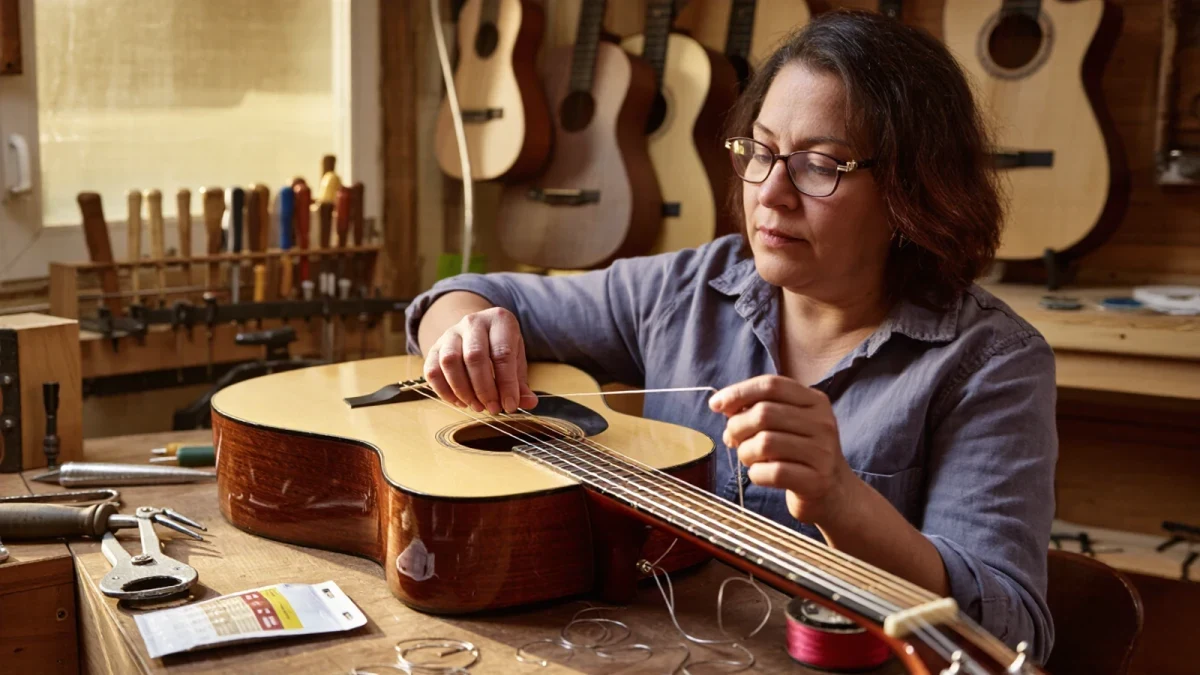
An acoustic guitar bridge comes in two documented formats: the pin bridge, used on Martin and Taylor dreadnoughts alike, anchors each ball-end string under a pin pushed into a bridgeplate; the pinless bridge — the documented house style of Ovation for decades and now associated with makers like Takamine and various travel builders — slots strings through channels in the bridge block itself. String changes on a pinless bridge are documented by their makers as noticeably faster because nothing is pressed in and nothing can drop and roll under the couch.
This is a sourced explainer: maker documentation and published repair references, no bench impressions, and one widely repeated tone claim examined and labeled for what it is.
How does a pin bridge work?
The pin bridge is the older and still dominant design. Each string's ball end slides into a hole through the bridge and bridges the bridgeplate — a hardwood layer inside the body — and a pin with a notch on its shaft holds the ball end locked against that plate. The string's tension pulls the ball against the bridgeplate, not against the pin itself, which is why setup references consistently note that a correctly seated pin is barely under load. Pins are made of plastic, wood, brass, bone, and Tusq, and are sold in sets from about $5 to $40, per current accessory listings as of June 2026.
The documented failure modes are familiar to any repair bench: pins that pop out because the ball end slipped alongside them instead of hooking the plate, and bridgeplate wear from decades of ball ends chewing into the plate holes — a documented repair category with a standard fix (dotted plate savers).
How does a pinless bridge work?
The pinless design, documented in Ovation's product history and current Takamine lines, runs each string through a channel that exits at the bridge's rear edge: thread the string, pull it across the saddle slot, tune up. No pins, no bridgeplate hook, no interior anchoring. The makers' claimed benefits are simpler and faster restringing, fewer small parts to lose, and a cleaner look at the saddle line.
The documented trade-offs sit at the extremes of cost: pinless bridges are more complex wooden parts to manufacture and replace, and because strings thread through the block, some designs make saddle work or bridge replacement more involved, per published repair references.
Does bridge type affect tone?
Here is the claim worth deflating: the persistent internet argument that pin bridges transfer vibration better because the string anchors to an interior bridgeplate. On the supplied evidence, no published controlled test supports an audible difference between the two anchor systems — and makers on both sides market their choice with tone language anyway. What is physically true — and documented in UNSW's guitar acoustics research pages — is that the bridge couples the strings to the top in either format, and that bridge mass, placement, and saddle material are bigger documented variables than the anchoring method. Treat the tone debate as unsettled folklore with confident parties on both sides.
What about string changes in practice?
Documented differences, per the makers' own instructions and published setup guides:
- Speed — pinless wins; thread-and-tune with no seating step.
- Pin loss and seating problems — pinless eliminates both; pin bridges occasionally need a pin wiggled or reseated.
- Bridgeplate wear over decades — a pin-bridge-only issue, with documented repair fixes.
- Compatibility — pin bridges accept every ball-end string universally; pinless channels occasionally interact with double-ball or unusual string ends, a corner case worth checking for unconventional string sets.
How do the two compare on paper?
| Aspect | Pin bridge | Pinless bridge |
|---|---|---|
| String anchoring | Ball end hooks interior bridgeplate | Threads through bridge block channels |
| Restring speed | Slower; seating required | Faster, per maker instructions |
| Small parts | Six pins, easily lost | None |
| Typical makers, per catalogs | Martin, Taylor, Gibson | Ovation, Takamine, travel builders |
| Tone difference | No controlled test supplied; claim is folklore | |
Which should influence a purchase?
It should not, much. Body design, tonewood, scale, and setup dominate what an acoustic does; bridge format is a convenience feature. If you change strings weekly and resent the fiddle, the pinless workflow is a documented quality-of-life gain. If you love traditional aesthetics or anticipate decades of ownership with possible bridge work, the pin bridge's ubiquity means every tech on earth has repaired a hundred of them — a serviceability point, not a tone point.
What did the sources not establish?
No supplied source measures restringing times head-to-head (the speed claims rest on maker instructions describing simpler procedures), and no controlled test compares tone or sustain between formats. Pin and bridgeplate repair costs are documented categories; comparative longevity of pinless blocks over decades is not. The honest summary: choose a guitar for its body and setup, and treat the bridge format as the convenience line on the spec sheet — which is exactly where the makers themselves put it.