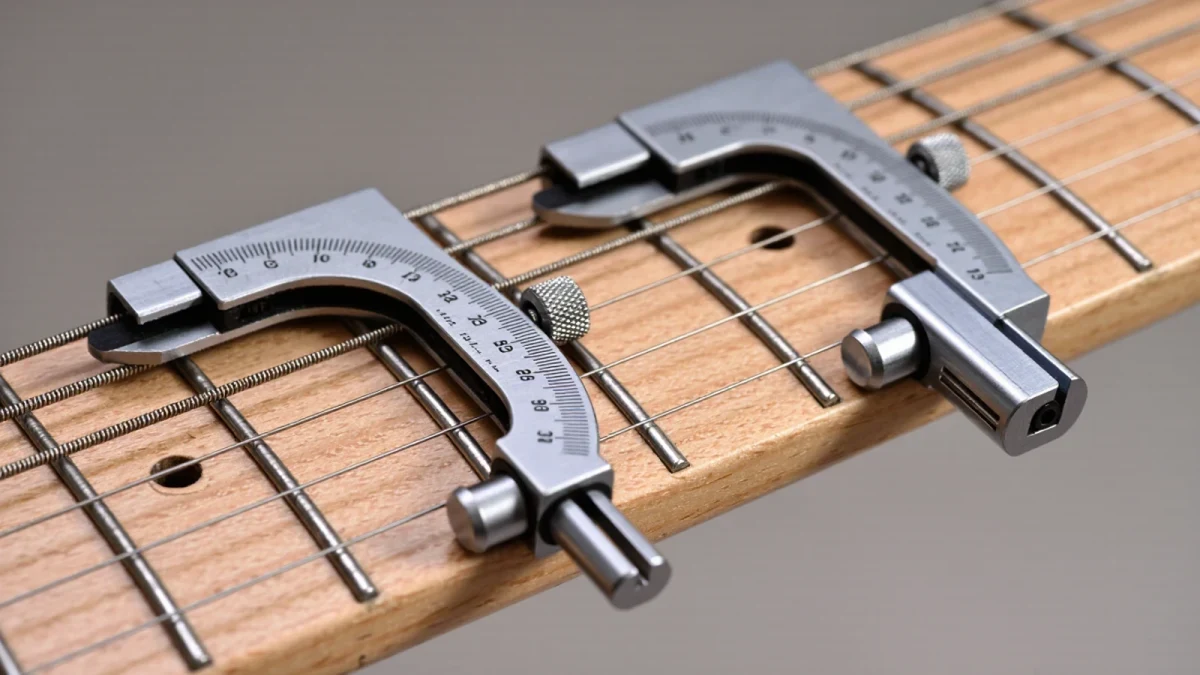
Fretboard radius is the curvature of the fingerboard measured across its width, expressed as the radius of an imaginary circle: Fender's modern standard necks run 9.5 inches per the maker's spec sheets, while Gibson's electrics typically run 12 inches — flatter, because a bigger radius means a shallower curve. The number matters in two places: string-to-fret contact under bends, where flatter boards keep strings from fretting out, and barre-chord comfort, where rounder boards can feel more natural to some hands. Vintage Fenders ran 7.25 inches, rounder still.
This is a sourced explainer: every figure below comes from maker documentation, and the feel statements are framed as maker claims or documented player accounts, never as this publication's hands-on impressions.
What is fretboard radius measuring?
Picture the fingerboard as a slice off the side of a cylinder. A 7.25-inch-radius board is a slice of a narrow cylinder — visibly arched. A 12-inch-radius board is a slice of a much wider cylinder — nearly flat. A 16-inch or compound board approaches flat. The spec appears on every serious spec sheet, usually as a single number like "9.5-inch radius (241 mm)" on Fender's Player Series documentation or "12-inch" on Gibson's Les Paul Standard pages.
Why did vintage Fenders use 7.25 inches?
The 7.25-inch radius on pre-1980s Fenders, per the maker's own vintage documentation and collector references, reflects a design era optimized for chord playing in the strings-and-big-band contexts the electric guitar grew from — the period the BBC's History of the World project covers in its electric guitar entry. The rounder board fits the shape of a relaxed fretting hand for closed-position chords.
The documented downside arrived with louder playing: on a 7.25-inch board, bending a string past about one whole step can push it into the higher frets' crowns and choke the note, a limitation repair literature addresses with higher bridge saddle settings or refrets with taller wire. Fender's own move to 9.5 inches as its modern standard, reflected across current Player and American Professional spec sheets, is the company engineering around exactly that problem.
What does a 12-inch board change?
Per Gibson's spec pages, the Les Paul Standard and SG Standard both carry 12-inch radii. A flatter board presents a more even string plane along the path a bent string travels, so notes bend cleanly at high frets without choking — the reason shred and high-gain players, per the makers' marketing and documented player interviews, gravitate toward 12-to-16-inch boards. Fast single-note runs also sit comfortably on the flatter plane.
The maker-acknowledged trade-off is barre-chord comfort: some hands find the flatter surface less natural for long closed-position stretches. "Some hands" is doing honest work there — hand shape varies, and no controlled study supplied for this guide measures comfort by radius.
What is a compound radius and who needs it?
A compound radius board starts rounder at the nut and flattens toward the body — a documented factory option in the 10-to-16-inch range on parts-maker Warmoth's neck catalog and on various premium production models. The logic is engineering, not marketing: round where you chord, flat where you bend.
Who needs it? Players who split time between rhythm work in low positions and lead work above the twelfth fret get the documented benefit. Players who live almost entirely in one territory can treat compound radius as a nice-to-have rather than a requirement.
How do the common radii compare on paper?
| Radius | Typical use, per maker docs | Documented character |
|---|---|---|
| 7.25 in | Vintage-style Fender reissues | Comfortable chords; bends choke more easily |
| 9.5 in | Modern Fender Player / American lines | Balance of chord comfort and bend clearance |
| 12 in | Gibson Les Paul and SG standards | Even plane for bends and lead work |
| 16 in + | Shred-oriented and metal models | Maximum bend clearance; flattest feel |
| Compound (10-16 in) | Aftermarket necks, premium models | Round low, flat high |
Can you change the radius on an existing guitar?
Yes, but it is a job, not a tweak. Re-radiusing means refretting: the luthier sands or presses the board to a new curve and installs new frets, work priced in the several-hundred-dollar range at typical repair-shop rates as of 2025. That figure is a general market observation from published shop menus, not one maker's quote, so verify locally. For most players, choosing the right radius at purchase beats re-engineering later.
Which radius should you choose?
Segmented by documented use: mostly chords and vintage-style playing — 7.25 or 9.5 inches. General-purpose electric work — 9.5 or the Gibson 12. Lead-heavy, bend-heavy, high-gain playing — 12 to 16 inches, or a compound board. And if you can only test one thing in a store: bend the high E a whole step at the seventeenth fret and let the string tell you whether the radius works. That single test exposes the whole trade-off faster than any spec chart.