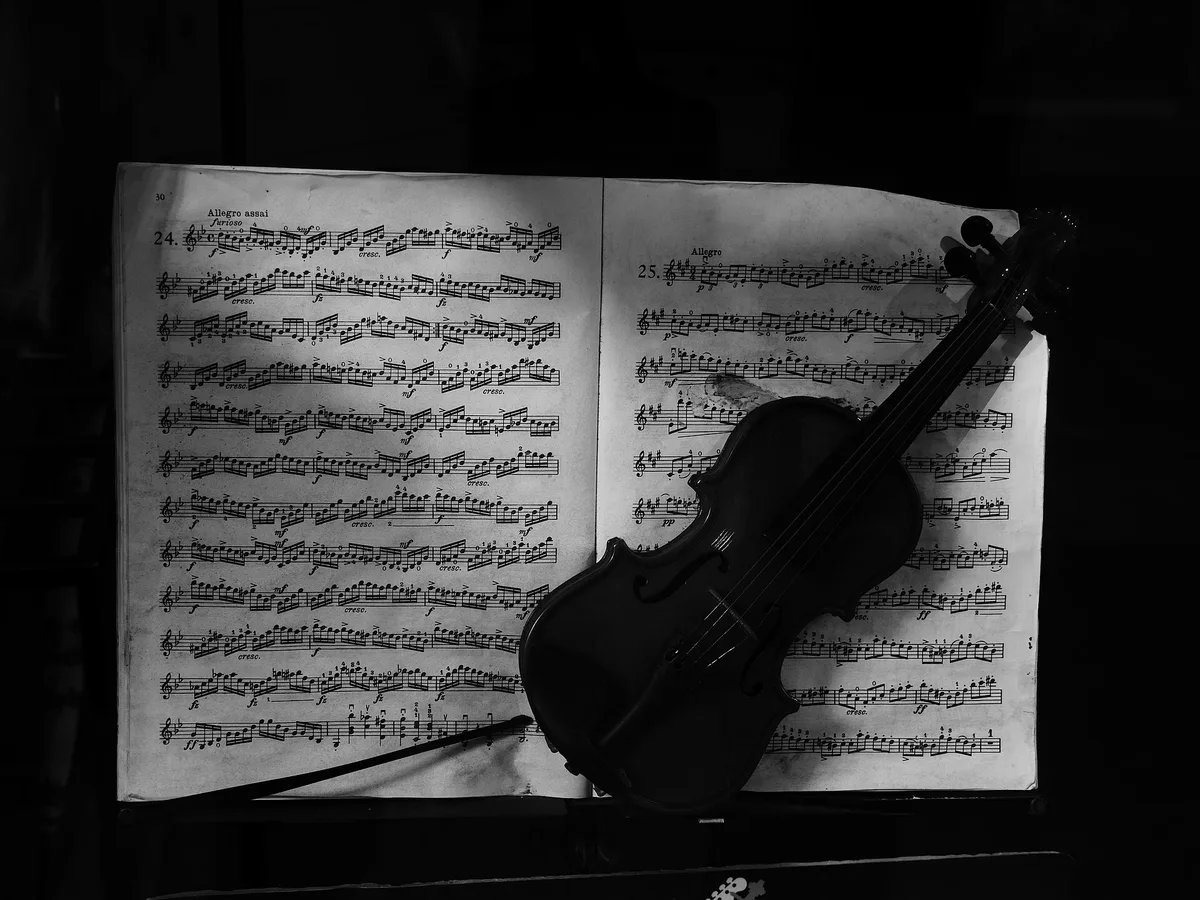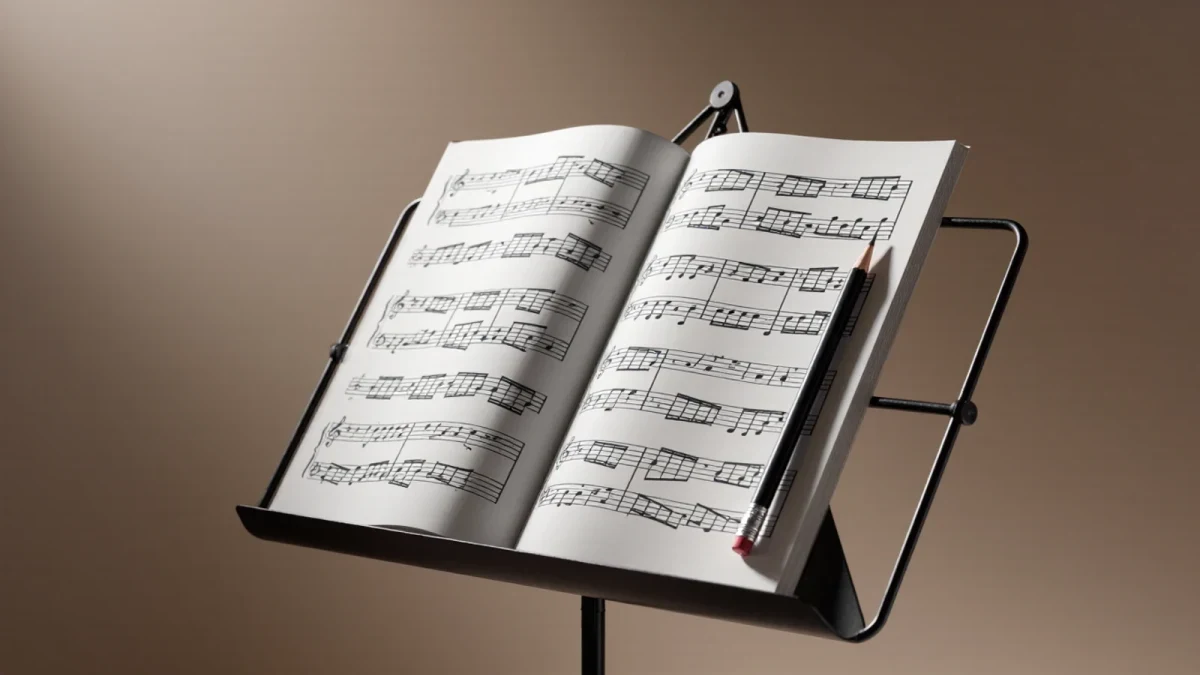
Reading sheet music on guitar means decoding one clef — the treble clef — plus rhythm symbols and position markings, and most players get functional in six to eight weeks of 15-minute daily sessions. That estimate follows the standard progression used in graded methods such as the Royal Schools and Suzuki guitar books, which structure early reading around a first-position note set of roughly 18 notes. Tab tells you where to put your fingers; notation tells you what the music is, in any key, for any instrument.
Why does guitar music use the treble clef?
Guitar music is written in the treble clef but sounds one octave lower than written — a convention notated with a small 8 under the clef in many editions. Your open low E string, the deepest note you play, is written on the staff as the E below the bottom line's neighbor even though it sounds much lower. The reason is simple ergonomics: writing guitar parts at actual pitch would bury them in bass-clef territory and split the music across two staves. One clef, one octave offset, everything on five lines.
The practical takeaway: when you read a C on the third space, you finger and name it as written. The octave transposition happens automatically in your ears. Only if you read alongside a pianist do you need to remember they sound an octave higher than your part looks.
What are the notes in first position?
First position means your left hand covers frets one through four, and it is where every method book starts. The open strings from low to high read E-A-D-G-B-E on the staff. The fretted notes fill the gaps between them. Learn landmarks rather than every note at once: the low E (bottom of the staff area), the D on the fourth line, the B in the middle, and the high E above the top line. From four landmarks you can count to any other note in seconds.
Standard graded repertoire confirms the payoff. The ABRSM and Trinity classical guitar syllabi place simple first-position reading pieces in their earliest grades, meaning exam boards expect functional reading within the first year of study — a reasonable pace for an adult beginner at 15 minutes a day.
How do you read rhythm at the same time?
Count rhythm separately from pitch at first. A whole note gets four beats, a half note two, a quarter one; eighth notes split the beat in two, sixteenths in four. Dotted figures add half the note's value, and rests are silences of matching length. Clap or count a new line before touching the guitar — a habit nearly every pedagogue's published method repeats, because hands that know the rhythm in advance stop stumbling halfway through the bar.
- Clap and count the line out loud, one bar at a time.
- Name the notes in rhythm, still without the guitar.
- Play it slowly enough that no note is a surprise — typically half tempo.
- Repeat the line three clean times before adding speed.
How do you know which string and fret to use?
Here is guitar's honest complication: one written note can live in several places on the neck. The E on the fourth line can be the open first string, the fifth fret of the second string, or the ninth fret of the third. Editions help you with position markings (Roman numerals for positions, circled numbers for strings), and beginner repertoire stays in first position where the choice is mostly obvious. As you advance, fingering becomes interpretation — the same note is brighter at the twelfth fret of a lower string than open, and editors' printed fingerings encode those choices.
Trust the printed fingering in graded editions; it was chosen by an editor who already solved the position puzzle. When an edition gives no fingering, the default rule is economical: prefer the lowest position that reaches every note in the phrase.
How is notation different from tab?
Tab shows string and fret — instant, but keyless and rhythm-optional. Notation shows pitch, duration, dynamics, and phrasing in one pass, which is why the classical repertoire, ensemble parts, and almost all pedagogical literature are printed in it. The two are complements, not rivals: many players sketch fingerings onto printed scores, effectively writing their own tab over the notation.
| Feature | Sheet music | Tab |
|---|---|---|
| Pitch and key | Explicit | Implied |
| Rhythm | Always notated | Often absent or approximate |
| Position guidance | Editorial fingering | Exact string and fret |
| Repertoire access | Classical, ensemble, jazz charts | Rock, folk, online transcriptions |
What should a beginner practice first?
Two minutes of note-naming drills, five minutes of clapping rhythms, then eight minutes of real music slightly below your playing level — that split is the working template. Use graded material so the difficulty rises in steps: the earliest Suzuki guitar pieces or Grade 1 anthology pieces fit under the fingers while still teaching new notes. Name every note aloud as you play it for the first weeks; silent guessing builds errors that take months to unlearn.
What the sources do not establish: no supplied study measures how quickly adult readers progress versus children, and no test compares learning speed from notation-first versus tab-first teaching. The six-to-eight-week estimate reflects method-book pacing, not a controlled study.