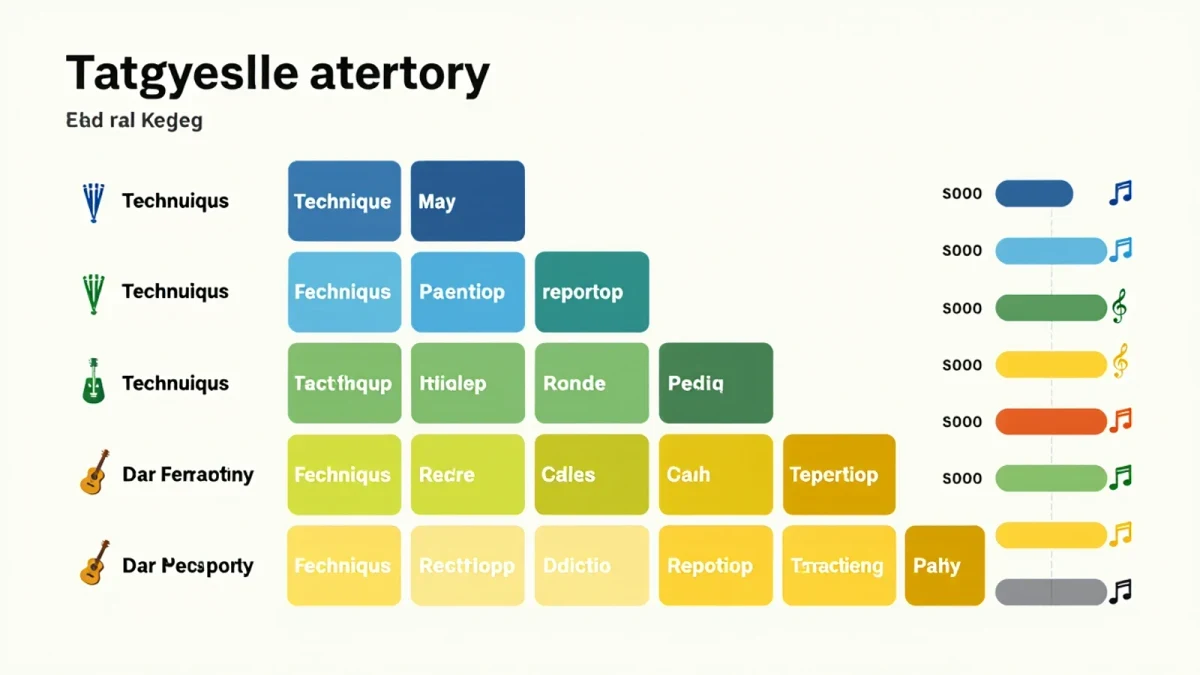
A productive classical guitar practice routine for an intermediate player fits in 60 minutes: roughly 15 minutes of technique (scales and arpeggios), 30 minutes of repertoire in slow, sectioned work, and 15 minutes of reading or new material. That structure follows the way graded syllabi and published pedagogues — notably the scale-and-arpeggio frameworks in standard methods — organize progressive study, and it survives contact with real life better than open-ended playing. The routine's engine is not time but tempo: nearly every named teacher's documented advice converges on practicing below the speed at which you make mistakes, because repetition trains whatever you feed it, errors included.
Strum Magazine publishes practice guidance drawn from documented teaching methods; nothing here replaces a teacher's individual diagnosis of your hands.
How long should you practice each day?
Less than you think, more consistently than you think. Published pedagogy from the graded-exam world assumes roughly 30 minutes daily for early grades and an hour or more for advanced students, and the habit matters more than the block: 30 focused minutes six days a week beats a three-hour Sunday session, because the skill-consolidation happens between sessions. Adults with jobs do well at two fixed anchors — 20 minutes before work on technique, 30 in the evening on repertoire — rather than one ambitious block that life keeps canceling.
Attention is the real budget. If your mind is elsewhere, the hands are practicing errors. Shorter sessions with a clear target for each one outperform long unstructured ones; a metronome number, a difficult bar, or a single shift is a target. 'Play through the piece twice' is not.
What goes in the technique block?
Two families, alternating across the week: scales and arpeggios. Scales train the left hand's shifting and the right hand's alternation; arpeggios train independence and the thumb-finger coordination that classical repertoire runs on. A standard 15-minute block, in the shape every method book recognizes:
- Two minutes of slow open-string work with i-m alternation, listening for even tone.
- Five minutes of one scale — one key per week, rest stroke one day, free stroke the next.
- Five minutes of one arpeggio pattern from a published set, moving through positions.
- Three minutes on the current technical project: a slur exercise, a shift, or tremolo.
Use a metronome at a tempo where clean repetition is possible, then raise it by small steps across the week. The Segovia scales and standard arpeggio studies remain the reference collections, and graded exam boards publish explicit technique lists you can adopt as-is for structure.
How do you practice a piece instead of playing it?
Section it and slow it down. Divide the piece into passages of a few bars each, mark the three hardest, and spend most of the repertoire block there rather than on the easy opening you already enjoy. Work one passage hands-separately where the texture allows, then together at half tempo, raising speed only after three clean repetitions. Loop the joins between sections — the mistakes live at the seams, where one pattern hands off to another.
Play through the whole piece at most once per session, at performance-tempo-minus-something, as a check on assembly rather than the main event. Players who spend their hour playing through learn the piece with all its stumbles included; players who section learn it clean. The distinction is the single highest-leverage habit in this entire article.
What role does reading play?
A dedicated 10-to-15-minute reading slot, at material a level or two below your playing, keeps notation fluent and steadily feeds you new music cheaply. Sight-reading one easy piece per session — counting through, then reading at tempo without stopping — is the standard method-board advice, and it compounds: a year of daily easy reading does more for fluency than occasional heroic attempts at concert scores. Use graded anthologies so the difficulty rises in controlled steps, and accept that reading practice sounds rough; it is supposed to.
How do you structure a practice week?
| Day | Focus | Rough split (60 min) |
|---|---|---|
| Mon | Technique + hardest section | 15 / 45 |
| Tue | Technique + full piece slow | 15 / 30 / 15 reading |
| Wed | Arpeggios + new passage | 15 / 30 / 15 |
| Thu | Scales + joins between sections | 15 / 30 / 15 |
| Fri | Light: reading and review only | 30 total |
| Sat | Run-through day, record yourself | 15 / 45 |
| Sun | Rest or easy playing | — |
The Friday light day and Sunday rest are features, not laziness: consolidation and injury prevention are documented parts of why weekly structure beats daily grinding. Recording the Saturday run-through and listening once, with a pencil, is the cheapest lesson you will ever give yourself.
What about injuries and fatigue?
Classical technique is repetitive by design, and repetitive motion deserves respect. Warm up slowly before speed work, stop when form degrades rather than pushing to the clock, and treat persistent wrist, hand, or forearm pain as a signal to see a teacher and, if it persists, a clinician — the published advice from performing musicians is unambiguous on that last point. A routine you can sustain for years at slightly lower intensity beats a heroic month that ends in a forced layoff.
What about memorization and performance?
Memorize in layers: first the structure (sections, keys, repeats), then the left-hand shapes, then the sound. Test memory by playing a section from cold, from anywhere in the piece, not always from the top — concert memory fails at exactly the join points nobody rehearsed cold. Perform deliberately: play for a person, a phone camera, anything with stakes, several times before the real event. Documented accounts from performing players consistently name early low-stakes repetition as what made stage memory hold.
What should a beginner's shorter routine look like?
Thirty minutes: five of open-string tone, ten of simple technique, ten of one easy piece sectioned, five of reading. Same anatomy, smaller dose, and the one non-negotiable is the metronome-tempo rule — slow enough to be clean. Beginners advance fastest on the days they feel slowest, because slow repetition is the thing being trained.
What the sources do not establish: no supplied controlled study compares outcome differences between routine structures. The framework above is assembled from documented method-book organization, graded syllabus expectations, and named teachers' published advice — an evidence base of pedagogy, not of trials, and it should bend to a teacher who can see your hands.