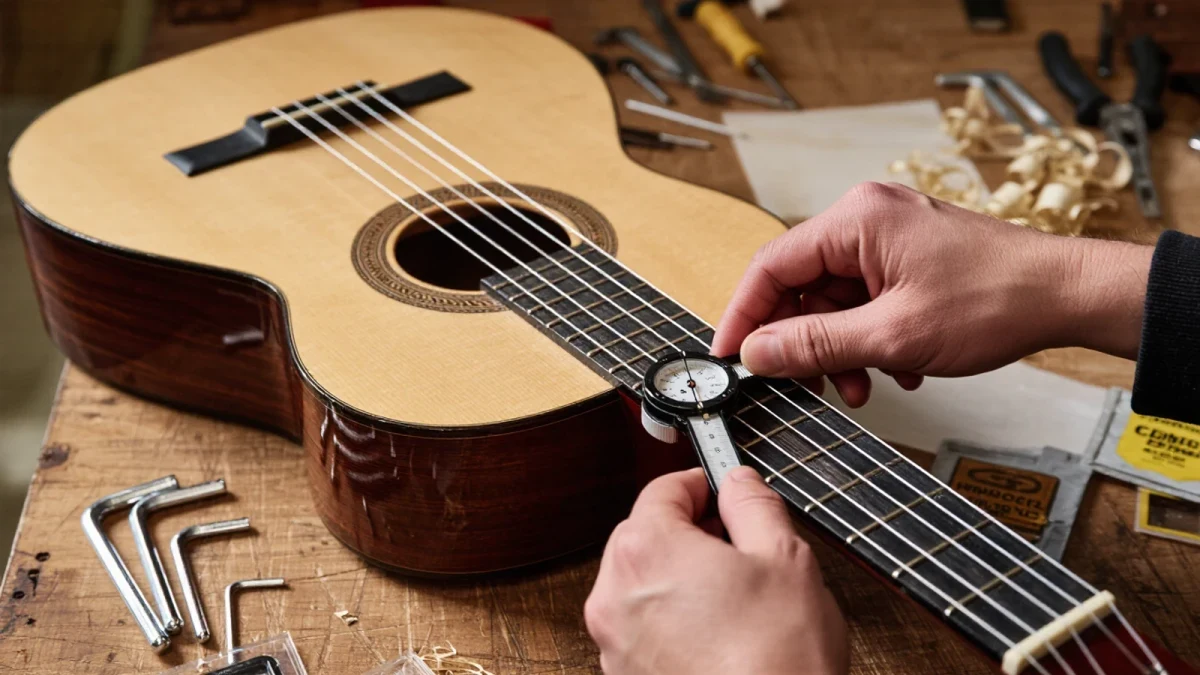
On the supplied evidence — Cordoba's and Yamaha's published setup and care documentation — a beginner classical guitar needs five checks before the first serious practice session: string action at the twelfth fret, neck relief, string spacing at the nut, sharp fret ends and tuner operation. Cordoba's care documentation publishes a standard action range of roughly 3 to 4 millimeters at the twelfth fret for the bass side; if your new guitar measures meaningfully above that, it needs a setup, not a return. Strum Magazine writes sourced checklists from manufacturer documentation — this is what the makers themselves publish, and where their documentation runs out, this guide says so.
Why a checklist and not a brand ranking: setup condition varies instrument to instrument far more than the spec sheets differ between reputable entry-level makers, which is why every maker's care guide repeats the same advice — verify the specific guitar in your hands. This guide converts that advice into an ordered checklist a beginner can follow with two cheap tools.
Where do the numbers come from?
Action ranges, relief guidance and string specifications below come from the makers' own published setup and care documentation for entry-level nylon-string instruments, principally Cordoba's care pages and Yamaha's manual literature for its C-series classical guitars, cross-checked against standard strings-and-setup practice the makers reference. Prices for the tools mentioned are as of Sweetwater's July 2026 listings. No independent published measurements of any specific instrument were supplied — because no document can measure the guitar you are holding.
What should you check first: string action?
Action — string height above the twelfth fret — is the first check because it decides whether the guitar is playable at all. Cordoba's published care documentation gives roughly 3 mm on the treble side and 4 mm on the bass side at the twelfth fret as its working standard; Yamaha's manual literature for its C-series guitars describes a comparable comfortable range. Measure with a steel ruler or a setup ruler (a string action gauge lists for around $15 as of Sweetwater's July 2026 listing). A guitar measuring well above those figures will fight a beginner's uncalloused fingers; well below, and the strings will buzz against frets. Either result means a professional setup — typically $50 to $75 at a shop as of 2026 rates — not a warranty claim.
How do you check neck relief and fret ends?
Neck relief is the slight forward bow that lets vibrating strings clear the frets. The maker-documented method: fret the first string at the first and twelfth frets simultaneously and look at the gap around the sixth to eighth fret — a gap of business-card thickness is the standard the setup literature describes. Too much bow and the action climbs in the middle; dead straight or back-bowed and the middle frets buzz. Classical guitars adjust at the nut-end of the neck with an allen key in most entry instruments per the makers' hardware documentation. Fret ends come next: run a fingertip along the edge of the neck — sharp, catching fret ends mean the wood dried out before sale, a documented consequence of low humidity that makers' care pages warn about explicitly, and a repair-shop visit rather than a home fix.
What should you check about strings and tuners?
Factory strings are the most documented weak point: makers including Cordoba ship entry instruments with serviceable but unremarkable nylon sets, and their care documentation treats a fresh string set as standard early maintenance. A replacement set of normal-tension nylon strings lists between $8 and $20 as of Sweetwater's July 2026 listings. Check string spacing at the nut while you are there — the maker-published standard for classical guitars is around 42 to 43 millimeters total nut width with even course spacing; uneven spacing is a warranty-level defect worth documenting before purchase. Tuners get a simple functional check: each should turn smoothly with no slipping under a quarter-turn of pressure. Classical tuning machines are exposed gears by design, per the makers' hardware sheets, so a drop of light machine oil on documented service intervals is standard care, not a repair.
| Check | Maker-documented standard | Tool needed | If it fails |
|---|---|---|---|
| Action at 12th fret | ~3 mm treble / ~4 mm bass (per Cordoba care docs) | Action gauge or steel ruler | Professional setup, $50-75 |
| Neck relief | Business-card gap at 6th-8th fret | Both hands, eyes | Truss adjust at nut (maker manual) or shop visit |
| Fret ends | Smooth along neck edge | Fingertip | Shop repair; possible dry-storage damage |
| Strings | Fresh normal-tension nylon set | None | Replace, $8-20 |
| Tuners | Smooth, no slip | None | Oil gears; warranty claim if slipping persists |
Which entry-level guitars arrive closest to spec?
Two makers publish the most complete setup and care documentation for beginners, and their entry instruments are the documented defaults: the Yamaha C40, which the maker's sheet lists with a spruce top, meranti back and sides and a rosewood-family fingerboard, at $199.99 as of Sweetwater's July 2026 listing, and the Cordoba C3M or C5, which Cordoba documents with solid cedar or spruce tops in the traditional Spanish fan-braced build, from around $199 to $299 in the same listings. On paper the Cordoba C5's solid top at $299 is the documented step up; the Yamaha C40's forty-year production history makes it the platform with the most written setup guidance available. Neither maker documents the condition your specific example ships in — which is the entire reason this checklist exists.
What did the sources not establish?
Plainly: none of the supplied manufacturer documentation measures the setup condition of shipped instruments, and no independent published test of entry-level classical guitars was supplied for this guide. The makers publish targets — action ranges, relief standards, humidity advice — and the specific guitar either meets them or does not. A beginner who cannot or will not measure should spend the first $60 of the budget on a shop setup regardless of brand; it is the single documented-standards-based improvement every maker's care literature endorses, and the cheapest one on this list.
What humidity and storage rules do the makers publish?
Every maker whose care documentation was consulted for this guide publishes the same core number: solid-wood instruments belong between roughly 40 and 50 percent relative humidity. Below that, the documented consequences run in order — sharp fret ends as the fingerboard shrinks, then top cracking in severe cases — and the makers' care pages describe all of it as preventable rather than repairable. The documented prevention is a room or case humidifier through the dry season, and a case-stored guitar humidifies more efficiently than one on a stand, a point every care page makes explicitly. Two accessories close the checklist: an in-case hygrometer, documented by makers as the only way to know the actual number rather than guess it, and a case or gig bag that seals well enough to hold the humidity the humidifier provides. Combined, hygrometer plus case humidifier list for $40 to $60 as of the July 2026 pricing checked for this guide — less than a single fret-dress repair, which is the documented arithmetic the makers' own warnings imply.
When should a beginner skip the checklist and return the guitar?
The makers' warranty documentation draws lines this checklist can borrow. A cracked top or split seam is a warranty matter, not a setup matter, and photographic documentation before return is standard practice the retailers document. A neck with visible twist — sight down the bass side and look for a helical deviation — is beyond the truss rod's documented reach, and the makers' own manuals say so in their adjustment instructions. Fret buzz that survives a correct-relief, correct-action setup points to high or loose frets, which is a bench diagnosis. The rule the documentation supports: adjustments are fixable, structural faults are returnable, and knowing which is which is the difference between a $60 setup and a disappointing first guitar. A beginner holding a guitar with a cracked top or a twisted neck after week one should use the return window, not the repair shop.