On the supplied evidence — Kyser's, Shubb's, G7th's and Thalia's product documentation with dated retail listings — the Shubb C1 steel-string capo at $26.99 street as of Sweetwater's August 2026 listing is the documented default for most players, because its adjustable screw tension is the mechanism the makers themselves describe as pressure-controllable, and tuning problems are the documented failure mode of every capo that clamps too hard. The Kyser Quick-Change at $24.99 is the one-hand speed option; the G7th Performance 3 at $99 is the clutched premium pick; the Thalia at $79.99 and up ships with the maker's documented interchangeable rubber fret fits. Strum Magazine compares from manufacturer documents — no testing bench here, and the honest gaps are named.
The comparison that matters is not brand against brand but mechanism against mechanism: spring, screw and clutch clamp differently, and each maker's documentation describes its own approach to the same problem — pressing strings down without pulling them sharp.
Where do the numbers come from?
Mechanism descriptions, materials, radii compatibility and prices come from the four makers' published product pages and packaging documentation, with street prices as of Sweetwater's August 2026 listings. Tonal and intonation claims are makers' claims. No independent published test measuring clamping pressure or pitch shift across these models was supplied for this guide — a gap that matters, because clamping pressure is the entire engineering problem a capo exists to solve.
How does each mechanism work on paper?
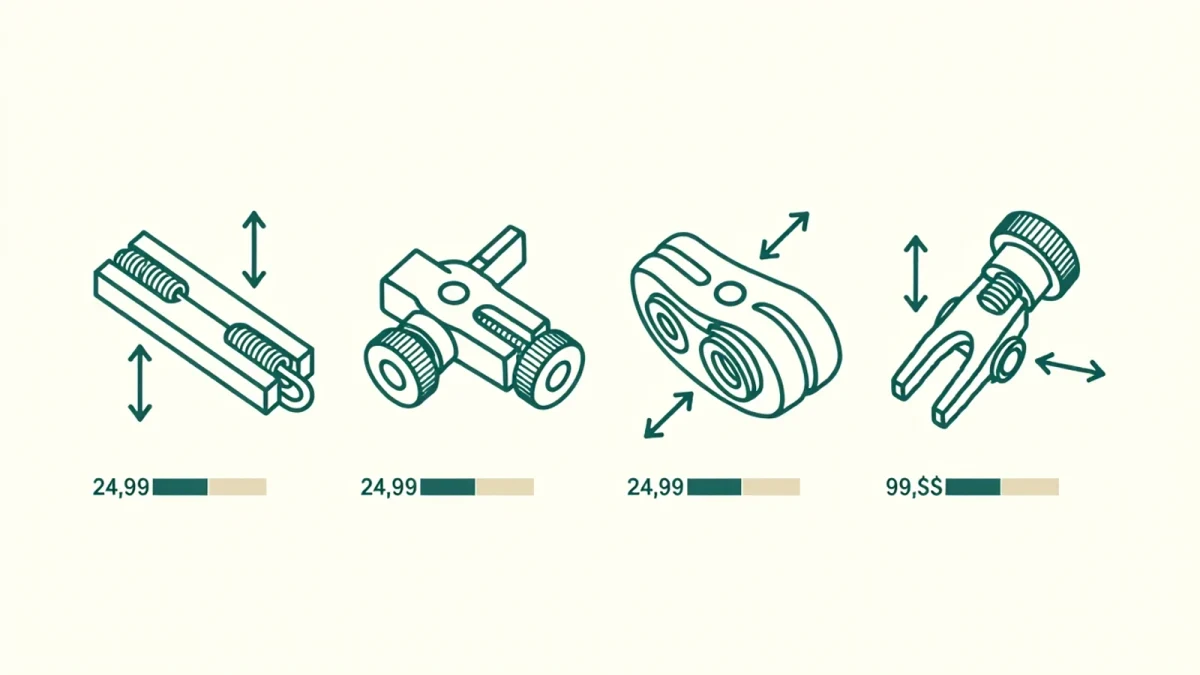
Kyser Quick-Change: a spring-loaded clamp the maker documents as one-hand operable — squeeze to move it, release to clamp. The spring's tension is fixed at the factory; the maker publishes no adjustment. Shubb C1: an over-centre lever with an adjustable thumbscrew the maker documents for setting tension, plus a screw that sets the closed position. G7th Performance 3: the maker documents a clutch mechanism it calls Adaptive Radius — squeeze to clamp, press the release to open, with tension stopping where your hand stops. Thalia: a snap-on design the maker documents with interchangeable rubber inserts sized for different fretboard radii, sold with a fitting kit. These descriptions come straight from each maker's documentation, and they are genuinely different solutions to the same physics.
| Capo (per maker docs) | Mechanism | Adjustable tension | Documented radius handling | Street price (Sweetwater, Aug 2026) |
|---|---|---|---|---|
| Kyser Quick-Change (6-string) | Spring clamp | No (fixed spring) | Curved for steel-string radii | $24.99 |
| Shubb C1 | Lever plus screw | Yes (thumbscrew) | Standard steel-string radius bar | $26.99 |
| G7th Performance 3 | Adaptive clutch | Yes (squeeze-set) | Maker's adaptive radius claim | $99 |
| Thalia 200 series | Snap-on with inserts | Fixed per insert | Interchangeable radius inserts included | $79.99 |
What are the strengths and trade-offs of each mechanism?
Spring (Kyser) strengths, per the maker: one-hand operation, the fastest documented capo to move mid-song; $24.99; nearly indestructible. Trade-offs: fixed tension means the same clamp on light and heavy string sets — the documented source of pulled-sharp tuning when the spring over-presses, which the screw-capo makers explicitly pitch against; storing it clamped on the headstock, the maker's own suggested storage, keeps the spring under load. Screw (Shubb) strengths: tension you set once per guitar per the maker's documentation; a design in production since 1980 with a documented service history. Trade-offs: two hands to move; slower between songs. Clutch (G7th) strengths: squeeze-set tension documented as adapting to the instrument; minimal storage footprint. Trade-offs: $99, nearly four times the Shubb, for a mechanism whose measurable superiority no supplied source establishes. Insert (Thalia) strengths: the only documented answer to mixed-radius collections — the maker ships radius-matched rubber fits; fine wood shells positioned as jewelry. Trade-offs: price, and moving it mid-song is not its documented strength.
Does a capo really pull strings out of tune?
Every screw- and clutch-capo maker in this comparison markets its pressure control as the fix for clamping-induced pitch rise, and the claim has a physical basis the makers describe consistently: a capo pressing down ahead of the fret adds downward pressure that can slightly stretch strings and pull them sharp, particularly on lighter gauges. That is the makers' explanation of their own products. What no supplied source provides is a measured comparison — pitch deviation in cents under each capo at matched positions — so this guide will not rank them on intonation. What the documentation does support: mechanisms with adjustable tension let you back off pressure until the strings ring clean, and fixed springs do not. If your capo'd guitar consistently tunes sharp, the documented culprit is clamp pressure, and the documented fix costs $26.99, not $99.
Which capo for which player?
Playing solo or recorded, where intonation is exposed and speed is not: the Shubb C1's documented set-and-forget tension is the standard answer at $26.99. Playing live covers with capo changes every third song: the Kyser's documented one-hand speed wins, and $24.99 makes it cheap enough to lose without grief. Owning guitars from vintage 7.25-inch-radius boards to modern 16-inch boards: the Thalia's interchangeable inserts are the only documented solution that does not involve owning several capos. Buying once and money no object: the G7th Performance 3's clutch is a genuinely elegant documented mechanism, and the maker's adaptive-radius claim — unverified by any supplied test — at least has a specific engineering description behind it. What the sources did not establish: measured clamping pressures, cents-of-deviation comparisons, long-term spring fatigue and rubber wear rates. Those numbers exist nowhere in the supplied documentation, and a buyer who sees them in a review is reading someone's bench, not the makers' sheets.
What about classical guitars and 12-strings?
The makers document radius-matched variants for a reason, and crossing instrument types is where buyers err. Classical guitars have flat fretboards — no radius at all — and every capo maker in this comparison publishes a dedicated flat or classical model; a curved steel-string capo on a flat classical board contacts fewer strings, which the makers' own fit guides describe as the cause of muted or buzzy outer strings. Twelve-strings invert the problem: doubled courses put more mass under the same bar, and the screw-adjustable makers — Shubb documents this explicitly — recommend lower tension settings on twelve-string to avoid pressing the octave pairs sharp against the fret. The Shubb C12 and Kyser's twelve-string model are documented variants in both makers' catalogs, priced within a few dollars of their six-string equivalents as of the August 2026 listings. Electric guitars with vintage 7.25-inch-radius boards are the third documented edge case: flatter modern boards suit most standard capos, but a tightly curved vintage board wants the flatter bar the makers list. One capo does not documentably fit everything — the honest answer is a model matched to the instrument, or the Thalia insert system for players who own several.