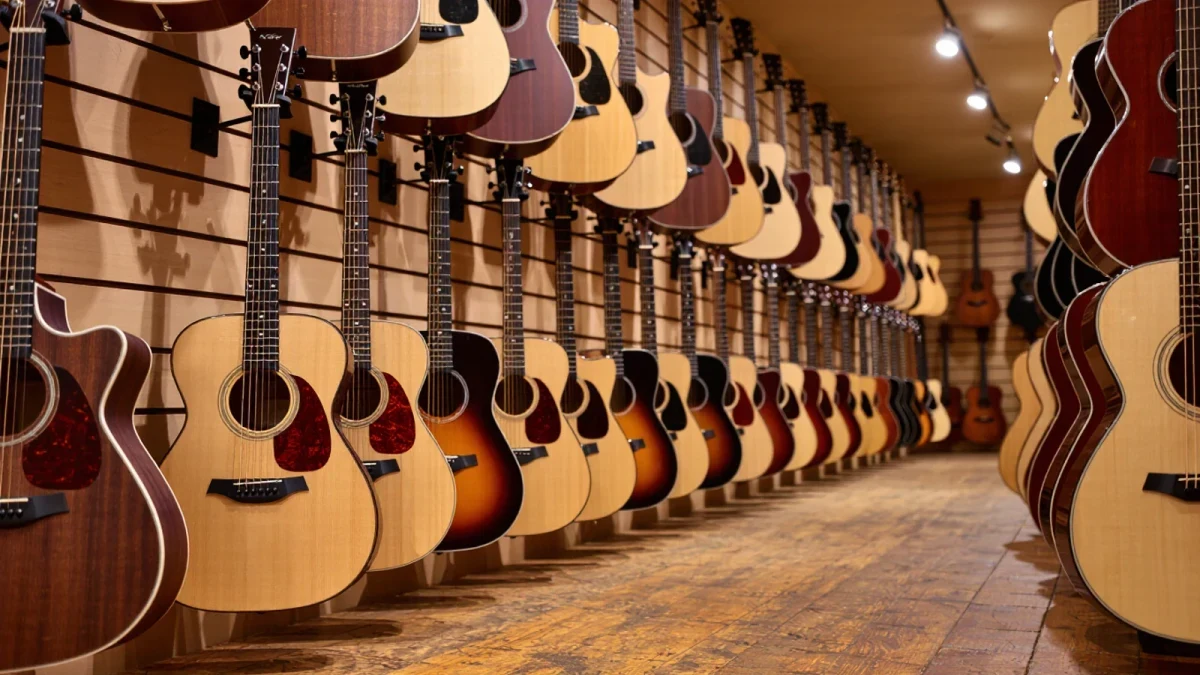
On the supplied evidence — Taylor's and Yamaha's spec sheets and Sweetwater's dated listings — the Taylor 114ce at $899 street as of Sweetwater's February 2026 listing is the pick under $1000 if you need a stage-ready acoustic with a pickup, and the Yamaha A1M at $799.99 as of the same listing is the value call if you can live without the Taylor's expression system polish. Both carry solid spruce tops per their makers' documentation, which at this price is the single specification most worth paying for. This is a sourced guide: Strum Magazine builds comparisons from manufacturer documents and dated prices, not from playing impressions.
Prices in the acoustic market have been moving — Reuters reported in April 2025 that US guitar makers were already adjusting to new import tariffs, so every figure below carries its date. Recheck listings before you buy.
Where do the numbers come from?
All four guitars below are described from their manufacturers' published specifications, with street prices as of Sweetwater's February 2026 listings. Where a maker claims a tonal character, it is flagged as the maker's claim. No independent published measurements of these specific models were supplied for this guide — where that matters, it says so.
What are the strengths and trade-offs at this price?
Taylor 114ce strengths, per Taylor's documentation: solid sitka spruce top; layered walnut back and sides; the Expression System 2 pickup with behind-the-saddle sensors; a 24.875-inch scale and 1-11/16-inch nut the maker describes as fast and comfortable. Trade-offs: back and sides are layered, not solid; the ES2's voicing is the maker's own claim. Yamaha A1M strengths: solid sitka spruce top, flamed maple laminate back and sides, an SRT-powered pickup system derived from studio mic modeling per Yamaha's own description, and a $100 lower price. Trade-offs: gloss-finished laminate body is less repair-friendly, and none of the supplied documents compare its amplified output to the ES2 directly. Seagull Maritime SWS strengths: solid spruce top and solid rosewood back and sides at $899 — the only all-solid wood in this group per Godin's spec sheet. Trade-offs: no electronics at that price, and a 1.8-inch nut that fingerstyle players may love and beginners may not. Alvarez MD70e strengths: solid spruce top, rosewood laminate, and a built-in pickup at $599.99, the lowest price here. Trade-offs: bi-level tops and bracing claims are the maker's, and hardware is commensurate with the price.
| Model | Street price (Sweetwater, Feb 2026) | Top | Back/sides | Pickup | Scale |
|---|---|---|---|---|---|
| Taylor 114ce | $899 | Solid sitka spruce | Layered walnut | Expression System 2 | 24.875 in |
| Yamaha A1M | $799.99 | Solid sitka spruce | Flamed maple laminate | SRT (maker's description) | 25.6 in |
| Seagull Maritime SWS | $899 | Solid spruce | Solid rosewood | None | 24.84 in |
| Alvarez MD70e | $599.99 | Solid spruce | Rosewood laminate | In-house piezo system | 25.5 in |
Why does a solid top matter more than anything else here?
Every maker in this group puts the word 'solid' in front of the top wood in its own documentation, and none of them put it in front of the back and sides at the same price without a trade-off. A solid top is a single piece of wood that the makers uniformly claim opens up over years of playing; that aging claim is manufacturer folklore repeated across the industry, not a measured result, and this guide flags it as such. What the spec sheets do establish: solid tops are standard on models makers position as serious instruments, and the sub-$1000 tier is where that feature starts. If a guitar in this range lists a laminate top, the price should reflect it.
How do the necks compare for different hands?
Per the makers' spec sheets, the Taylor 114ce carries a 1-11/16-inch nut on a tropical mahogany neck; the Seagull Maritime SWS carries a wider 1.8-inch nut that Godin documents as part of its North-American-fingerstyle orientation; the Yamaha A1M sits between them; the Alvarez follows a conventional dreadnought pattern. For a strummer with average hands, any of them works. For a beginner still building fretting accuracy, the wider Seagull nut gives more room between strings at the cost of tougher barre chords — that is a geometric fact from the spec sheet, not an impression. Scale length differences here are small — 24.84 to 25.6 inches — but string tension rises with scale, so the shortest scale reads as slightly slacker with identical strings.
What about electronics and playing out?
If you plug in regularly, the spec sheets point to the Taylor 114ce's Expression System 2, which Taylor documents as three sensors positioned behind the saddle rather than under it — a design the maker claims reduces piezo quack. That claim is Taylor's own; no independent published measurement of the ES2 against Yamaha's SRT system was supplied for this guide. The Yamaha A1M's SRT system is described by Yamaha as blending an under-saddle pickup with studio-mic modeling, again a maker's description. The Alvarez's system at $599.99 is serviceable per its spec sheet but is the least documented of the three. None of this settles which sounds better through your amp — it establishes what each maker has actually built and claimed.
Which guitar for which player?
First serious acoustic, plugged or unplugged, budget at the top of the range: the Taylor 114ce at $899 as of February 2026 is the safest documented pick — solid top, named pickup system, and the widest dealer support. Value-first player who still gigs occasionally: the Yamaha A1M at $799.99 gives you a solid top and a described-as-sophisticated pickup for a hundred less. Home player who never plugs in and wants all-solid wood: the Seagull Maritime SWS is the only guitar in this group with solid back and sides per its maker's sheet, and the $899 goes into wood instead of electronics. Working beginner on a tight budget: the Alvarez MD70e at $599.99 gets a solid top and a pickup on stage with money left for a case and a setup.
What the sources did not establish: none of the supplied spec sheets or listings measures tone, projection or build consistency between individual instruments, and no named published tests of these four models were supplied. Play before you buy if you can — the numbers narrow the field; the specific guitar on the wall makes the final decision, and no sourced document replaces that step.