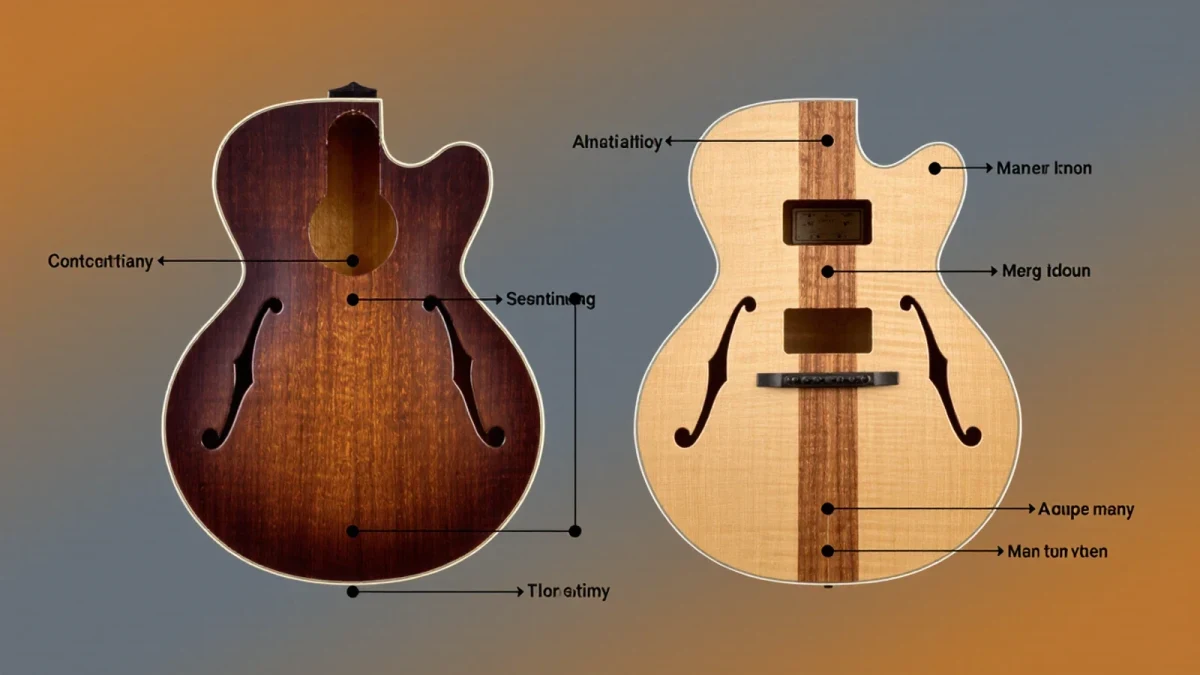
On the supplied evidence — Gibson's, Ibanez's and Gretsch's spec sheets with Sweetwater's dated listings — the semi-hollow guitar with a maple center block is the more versatile default, and the full hollowbody is a specialist instrument. The practical split is one specification: a center block, present in the Gibson ES-335's lineage since 1958 per Gibson's own documentation, adds mass that resists feedback and sustains; a fully hollow body, like the Ibanez Artcore AF95 at $599.99 street as of Sweetwater's February 2026 listing, gives you an acoustic chamber at the cost of amplified stability. Strum Magazine writes sourced guides from manufacturer documents — no hands-on impressions here, and every price is dated.
The Associated Press's history of the electric guitar traces how the hollow archtop came first and the solidbody and center-block designs followed to solve amplification problems; the spec sheets below show the same logic still running the category.
Where do the numbers come from?
Construction details come from the makers' published specifications for the Ibanez Artcore AF95 (full hollow), Ibanez Artcore AS53 (semi-hollow), Gretsch G5420T (full hollow) and Gibson ES-335 (semi-hollow). Street prices are as of Sweetwater's February 2026 listings. Tonal characterizations are makers' claims and are labeled as such; no independent published measurements of these specific models were supplied for this guide.
What is a center block and why does one strip of maple decide everything?
Per Gibson's documentation, the ES-335 pairs a hollow maple-poplar-maple body with a solid center block running its length, on which the pickups and bridge mount. The maker's stated purposes are feedback resistance and added sustain — Gibson's claims, but structurally verifiable in the sheets: the block is listed as a construction feature on every 335-family guitar. A full hollowbody like the AF95 lists no such block; its pickups mount to the top itself, and the entire body cavity is open. The consequences the specs support: the semi-hollow tolerates higher stage volumes, and the hollowbody works as a quiet practice instrument unplugged in a way a center-block guitar does not, because the open chamber moves more air.
How do the four guitars compare on paper?
Ibanez Artcore AF95: full hollow, spruce top per Ibanez's sheet, hollow-body depth listed around 3.54 inches, $599.99. Ibanez Artcore AS53: semi-hollow, linden top and body with the block, thinner profile, $499.99 — the least expensive way into center-block construction in this comparison. Gretsch G5420T: full hollow with Filter'Tron-style Black Top pickups per Gretsch, a Bigsby-style vibrato tailpiece, $1,499. Gibson ES-335: semi-hollow, the reference design, $4,999 as of the February 2026 listing. The price spread is the story: at the entry tier Ibanez sells both constructions for under $600, while the reference semi-hollow costs eight times the entry model.
| Model (per maker sheets) | Construction | Pickups | Vibrato | Street price (Sweetwater, Feb 2026) |
|---|---|---|---|---|
| Ibanez Artcore AF95 | Full hollow, spruce top | 2x humbucker (Artcore FX) | No | $599.99 |
| Ibanez Artcore AS53 | Semi-hollow, center block | 2x humbucker (Infinity R) | No | $499.99 |
| Gretsch G5420T | Full hollow | 2x Black Top Filter'Tron-type | Bigsby-style tailpiece | $1,499 |
| Gibson ES-335 | Semi-hollow, maple center block | 2x humbucker (Calibrated T-Type) | No (stock) | $4,999 |
What are the strengths and trade-offs of each construction?
Full hollow strengths, per the makers' sheets: genuinely acoustic unplugged response; the classic jazz and rockabilly voicing the makers claim for their open chambers; lighter weight on average. Full hollow trade-offs: documented feedback sensitivity at volume — every maker in this comparison sells the center block as the fix; bridge mounting to a floating top is more repair-involved; body depths of three and a half inches and more feel large seated. Semi-hollow strengths: the block-mounted hardware, the feedback resistance the makers document as the design's purpose, and sustain claims that at least have a physical mechanism behind them. Semi-hollow trade-offs: less unplugged volume; slightly higher average weight; less of the acoustic woof the hollowbody makers advertise.
Which one should a jazz player buy?
If you play seated at conversation volume, the full hollowbody is the documented tool: the AF95 at $599.99 is the value entry, and the Gretsch G5420T at $1,499 adds the vibrato and pickup character Gretsch documents. If you play with a drummer, the spec sheets change the answer — a center-block guitar holds up where an open chamber howls, which is why Gibson's 335 documentation pitches it as the workhorse. The AS53 at $499.99 is the cheapest documented route to that stability.
Which one should a rock or blues player buy?
The semi-hollow is the default on the supplied evidence. The center block exists, per the makers' own history, because players amplified hollow guitars and the guitars fed back; the block solved it and the 335 became the genre-spanning instrument its maker claims. A rock player choosing between the AS53 and AF95 at similar prices is choosing stability over acoustic character, and the sheets make the stability case mechanically. What the sources did not establish: none of the supplied documents measures sustain duration, feedback thresholds or acoustic output in decibels — those specific numbers do not exist in this guide because they do not exist in the sources, and any you see elsewhere came from someone's test bench, not a spec sheet.
How do f-holes and body depth change the practical experience?
Every guitar in this comparison lists f-holes in its maker's sheet — the twin openings on the top that visually define the category. Documented consequences follow from them. First, the openings couple the internal chamber to the air, which the makers credit for the acoustic responsiveness they claim; they also admit stage noise into the body, one more documented path to feedback that the center block was designed to damp. Second, body depth: the AF95's listed depth of roughly 3.5 inches and the G5420T's comparable dimension make these the largest guitars most players will hold, where the semi-hollow AS53's thinner profile lists meaningfully slimmer dimensions. Seated players notice depth before they notice weight, and a three-and-a-half-inch body sits differently on a strap than a slab solidbody — practical geometry, not tone talk, and every number here is from the sheets. A final practical note the sheets support: hollow and semi-hollow bodies house electronics and wiring in an open chamber, so any wiring fault means working through the f-hole, a repair path every qualified tech knows and every spec sheet implies.