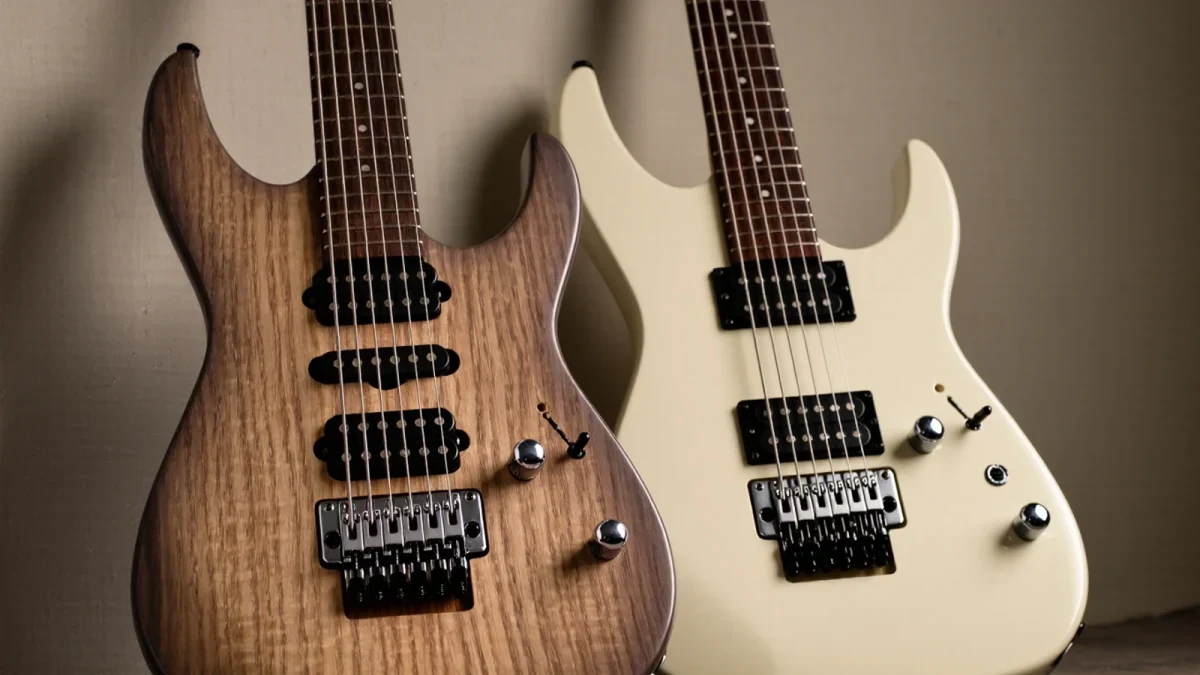
On the supplied evidence — Fender's own spec sheets for the Player II Stratocaster and Player II Telecaster, both listed at $849.99 street as of Sweetwater's January 2026 listing — the Stratocaster is the broader tool and the Telecaster is the sharper one. The Strat gives you three pickups, a two-point tremolo and a contoured body; the Tele answers with a flat slab body, a fixed bridge and a famously direct bridge pickup. Neither is better. They solve different problems, and the specs make the split plain.
Strum Magazine publishes sourced guides from manufacturer documentation, not hands-on testing; every number below comes from Fender's published specs, and every price is dated. Here is where the comparison actually lands.
Where do the numbers come from?
Both guitars compared here are the current Player II versions, which Fender introduced for 2024. Per Fender's spec sheets, the two share more than they differ: 25.5-inch scale length, 22 medium jumbo frets, a 9.5-inch-radius pau ferro fingerboard on a modern C maple neck, alder body, and standard cast/sealed tuners. Prices are street prices as of Sweetwater's January 2026 listing, where both models list at $849.99 regardless of finish. What the shared spec sheet tells you is that Fender treats these as one platform with two personalities.
What does each body do differently?
The Stratocaster carries a double-cutaway alder body with forearm and belly contours, which the maker describes as comfort carving. The Telecaster is a single-cutaway slab with no contours — a lighter, flatter piece of wood that, per Fender's own weight figures, typically lands a few ounces lighter on the same scale length. The Strat's two-point tremolo bridge routes strings through the body and allows bending; the Tele's six-saddle strings-through-body fixed bridge does not move. That single hardware choice drives most of the practical difference: the Tele stays in tune under heavy picking with nothing to manage, while the Strat offers vibrato at the cost of a floating bridge that needs occasional setup attention.
How do the pickups and controls compare?
Per Fender's spec sheet, the Player II Stratocaster has three Player Series Alnico 5 single-coils with a five-way blade and a two-point synchronized tremolo, plus push-pull tone pot adding series wiring on some configurations. The Player II Telecaster has two Player Series Alnico 5 single-coils, a three-way blade, and the traditional single tone control. Practically: the Strat gives you five voicings including in-between positions favored for rhythm work; the Tele gives you three, but its bridge position — a steel-saddled single-coil mounted in that angled metal plate — is the sound the model is known for. As the BBC noted in its history of the instrument, Leo Fender's 1950 solid-body design set the template the Tele still follows, and its directness is the point.
| Spec (per Fender sheets) | Player II Stratocaster | Player II Telecaster |
|---|---|---|
| Street price (Sweetwater, Jan 2026) | $849.99 | $849.99 |
| Body | Alder, double cutaway, contoured | Alder, single cutaway, slab |
| Pickups | 3x Player Series Alnico 5 single-coil | 2x Player Series Alnico 5 single-coil |
| Controls | 5-way, 1 vol, 2 tone | 3-way, 1 vol, 1 tone |
| Bridge | 2-point tremolo, string-through | 6-saddle fixed, string-through |
| Scale / frets / radius | 25.5 in / 22 medium jumbo / 9.5 in | 25.5 in / 22 medium jumbo / 9.5 in |
What are the strengths and trade-offs on each side?
Stratocaster strengths, per the spec sheet and maker claims: five pickup positions; tremolo facility; contoured comfort; a second tone control. Stratocaster trade-offs: the floating bridge needs periodic setup; the thinner neck position can sound thinner — a maker claim, not an independent measurement; more switches for a beginner to learn. Telecaster strengths: fixed bridge stability; the plate-mounted bridge pickup voice the maker describes as 'snappy and articulate'; simpler control layout; typically lighter weight. Telecaster trade-offs: no vibrato; a slab body some players find less comfortable seated; only three sounds.
Honest gaps: none of the supplied manufacturer documents measure sustain, resonance or tuning stability, and no independent published test of the Player II pair was supplied for those claims either. Weight ranges on Fender's sheets are approximations, and individual instruments vary.
Which one should a beginner buy?
If you are buying a first electric guitar and have $849.99 budgeted as of January 2026, the Stratocaster's five positions cover more ground while you are still discovering what you play — and its tremolo teaches bridge management later, not on day one. If you already know you play country, indie rhythm or anything built on a bright, immediate attack, the Telecaster's fixed bridge and bridge-plate pickup are the working tool, and the money you are not spending on a tremolo system shows up as stability.
How do string changes and maintenance differ?
Because the Telecaster's bridge is a fixed six-saddle unit, a string change is a two-minute job with no knife-edge pivots to lubricate and no spring tension to balance against string gauge. Per Fender's setup literature, switching to a heavier set on a Tele means a truss-rod check and maybe a saddle height tweak. The same gauge change on the Stratocaster also involves the tremolo springs: the two-point bridge floats on spring balance, and a heavier string set pulls the bridge plate up unless you add spring tension at the claw. None of this is difficult, but the Strat asks you to learn a system, and the Tele does not. Players who change tunings often — drop D, open G — will spend less time at the bench with the fixed bridge.
What about resale and model breadth?
Both shapes run deep in Fender's catalog above and below the Player II tier, which matters for resale and for future upgrades. The same platform exists as the American Professional II series at roughly triple the street price, and as the more affordable Squier versions below it — meaning the neck profile, control layout and bridge design you learn on a Player II transfer directly up and down the range. Neither shape is at risk of discontinuation; both have been in continuous production in some form since the 1950s, per the company's own historical documentation. On resale specifically, no supplied document provides depreciation data, so treat durability of demand as a qualitative point, not a number.
Which one should a step-up player buy?
For a player upgrading from an entry-level instrument, the question is whether you use vibrato. Players who rest a palm on the bridge and bend will want the Strat. Players who tune once a night and want one authoritative rhythm and lead voice will keep reaching for the Tele. On the supplied evidence both guitars are the same price, same neck, same scale — so the honest recommendation is to choose the hardware, not the headline, and accept that neither spec sheet proves anything about tone that your own hands will not decide.