What made Ace Frehley great? According to MusicRadar, John 5 gives a two-part answer: pure, unteachable talent, and something he calls the whole package. The Mötley Crüe guitarist spoke to the publication for the launch of his signature Fender Telecaster collection, roughly a year after Frehley's passing, and the conversation turned to the man he calls one of the very few players who had it all.
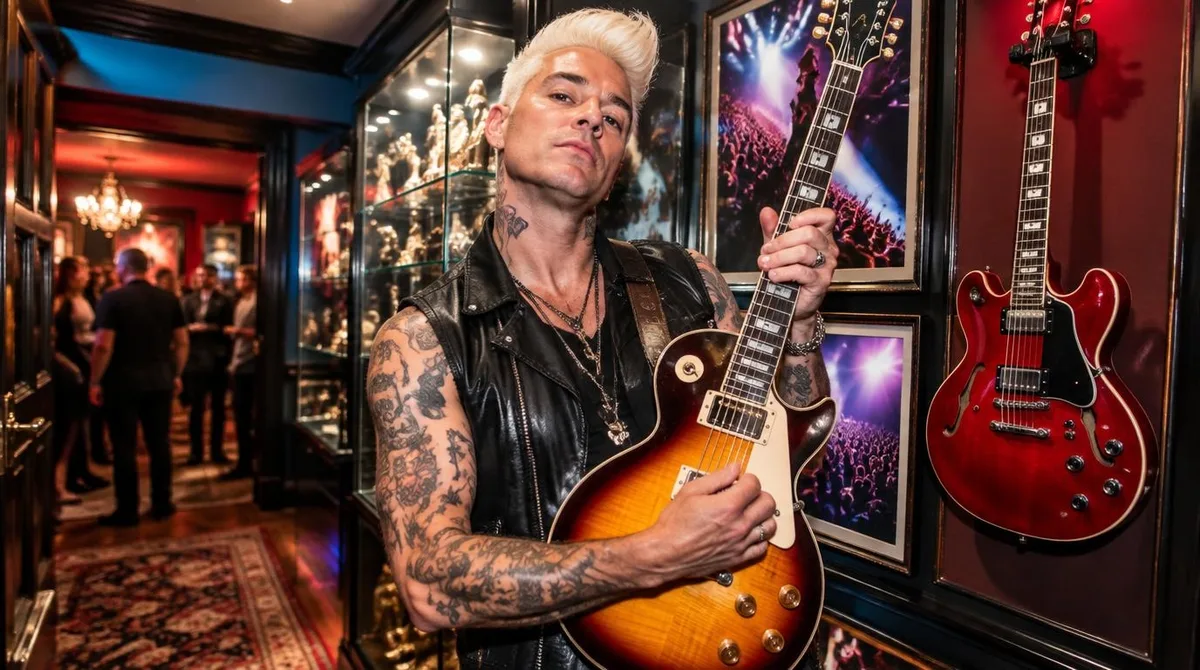
That answer matters because it comes from someone with unusual standing to give it. John 5's Kiss memorabilia collection grew so large that he built a museum at his home — the Knights In Satan's Service Museum — and opened it to the public for guided tours last year, per MusicRadar. This is not a casual fan offering a eulogy. It is a working guitarist who lived the friendship, covering Cream, Jimi Hendrix and the Beatles on his solo records Origins Vol 1 (2016) and Origins Vol 2 (2020), on which both he and Frehley covered the Kiss song Parasite. When John 5 made his live debut with the Crüe, Frehley was in the audience as his special guest.
Read closely, the interview is really a theory of what separates a great guitarist from a great guitar hero — and it is worth unpacking for anyone who has ever argued about it on a forum or in a rehearsal room.
What exactly did John 5 say about Frehley's talent?
He framed it as something that cannot be taught. "Just the writing, and the solos, and all that stuff, that's something you can't learn, and you can't be taught that," John 5 told MusicRadar. "That's just pure talent."
That is a strong claim from a player known for technical command. But the logic holds up: John 5 is separating skill, which practice builds, from instinct, which does not. Frehley was never the shredder's shredder. What John 5 identifies is the thing listeners hear before they can name it — writing and phrasing that feel inevitable rather than constructed. For learners, the implication is uncomfortable but useful: you can woodshed scales forever and still not arrive at that quality, because it was never a technique problem in the first place.
Why does "the whole package" keep coming up?
Because it is rare, and John 5 says so with numbers. "When you talk about the whole package, it was the whole package," he told MusicRadar. "The look. I mean, the look! Having someone who's cool... The riffs, the solos, the whole vibe... and that is so rare."
His shortlist is telling: Jimmy Page, Eddie Van Halen, Randy Rhoads, Dimebag, Hendrix. "There's so many great, phenomenal guitar players, but very few had the whole package," he said. He also put Mick Mars — the man he replaced in Mötley Crüe — on that list: "He looked cool. He had great riffs, great solos."
The analytical point is that the package is a bundle, and bundles fail at the weakest link. As the MusicRadar piece puts it, many players have some of it — they look cool but can't play, or can play but aren't cool. Frehley's stagecraft was part of the same bundle: smoke from the guitars, rockets fired from a headstock, stunts the piece notes were technically dangerous. The danger was not separate from the music. It was part of the same rawness John 5 hears in the playing itself — a style that, in the piece's words, didn't let technique housetrain it. This connects to our earlier piece, Electric-Acoustic Guitars: Sourced Guide.
Where does tone fit into all this?
Right at the end, and it is the most practical thing John 5 says. "Great tone, incredible tone," he said of Frehley, Mars and Van Halen, before invoking Eddie Van Halen's own line: "I sound like Eddie Van Halen playing acoustic guitar, because most of it's in your hands."
For anyone chasing the sound through gear, that is the honest read from a player who has just launched a signature Telecaster line. The instrument matters, but the hands come first — a view John 5 attributes to Van Halen himself. It is also why the same player can pick up almost anything and still sound like himself. If you are weighing your next electric, our Strat vs Tele: The Sourced Comparison covers the specs, but John 5's point is that no spec sheet closes the gap on its own.
Where should a curious player start with Frehley's Kiss work?
John 5 himself struggled to pick one. In 2016 he told MusicRadar that "I Stole Your Love" from 1977's Love Gun was the song that changed his life. Asked again now, he paused, then landed on "Love Her All I Can" or "Rocket Ride" — "just any of those early albums are the best," per MusicRadar.
The hesitation is the takeaway. A superfan with a museum in his house could not narrow it to one track, which tells you the appeal was never a single solo or riff. It was a run of records where the writing, the sound and the character arrived together.
What does this interview actually change for players?
Not much on paper — a tribute, a song list, a signature-guitar launch. But it quietly resets how we talk about influence. The players we call heroes are not the ones with the fastest runs. They are the rare few where talent, tone, look and presence held together, and John 5's argument is that you can count them on two hands. Frehley, in his telling, was one of them. That is a standard worth arguing with, and the kind of argument our Artists coverage keeps returning to: not who played hardest, but who made it all add up.